
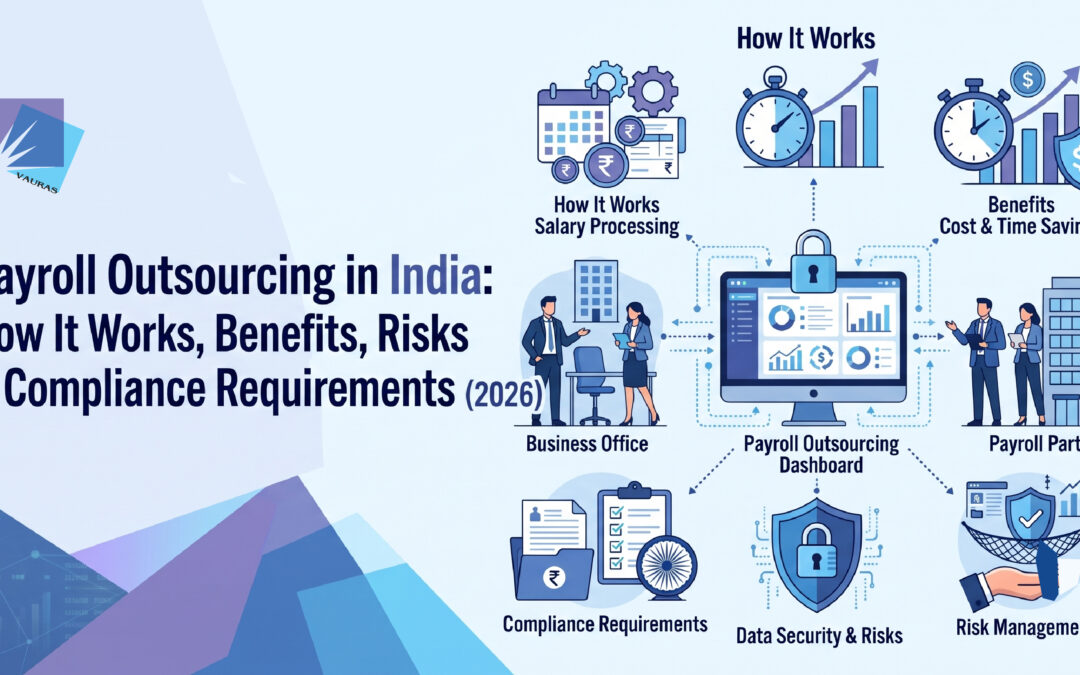
Payroll outsourcing in India means appointing an external provider to carry out agreed payroll tasks, such as salary calculations, payslips, reporting and statutory compliance support. The employer continues to supply accurate employee information, approve payroll and oversee its legal obligations. Outsourcing changes who performs the work; it does not automatically transfer employer liability.
For founders, finance heads and HR leaders, the useful question is whether a provider can make monthly payroll more dependable while preserving visibility and approval rights. This guide explains the operating model, the risks to manage and the compliance responsibilities to clarify before signing.
What payroll outsourcing includes
A typical scope begins with maintaining employee payroll records and processing approved attendance, leave, earnings and deductions. Depending on the contract, it may extend to statutory workings, return preparation, payment files, employee queries and year-end support. Ask the provider to list deliverables rather than relying on the phrase end-to-end payroll.
Payroll processing for your own employees is different from staffing or employer-of-record arrangements. In a processing engagement, your company generally remains the employer. If a proposal refers to third-party payroll or contractor payroll, establish who employs the workers, who funds payments and which responsibilities each party accepts.
Outsourcing managed payroll and software compared
|
Model |
Who performs monthly work |
What the buyer must clarify |
|---|---|---|
|
Payroll software |
Your internal team uses a platform |
Who configures rules and checks outputs |
|
Payroll outsourcing |
A provider performs contracted tasks |
Calculations only or filings and support too |
|
Managed payroll |
Usually an ongoing outsourced service with defined operations |
Named owners SLAs exceptions and reporting |
|
Payroll advisory |
Specialists review rules controls or a specific problem |
Advice and deliverables versus execution |
Managed payroll and payroll outsourcing frequently overlap. There is no universal commercial boundary between the labels. Software can support either model, but buying access to a tool does not by itself buy a payroll operations team.
If your immediate issue is selecting the right model, continue with our in-house payroll versus outsourcing comparison. If the operating model is already agreed, use the payroll outsourcing cost guide to define a comparable quote.
How the monthly payroll process works
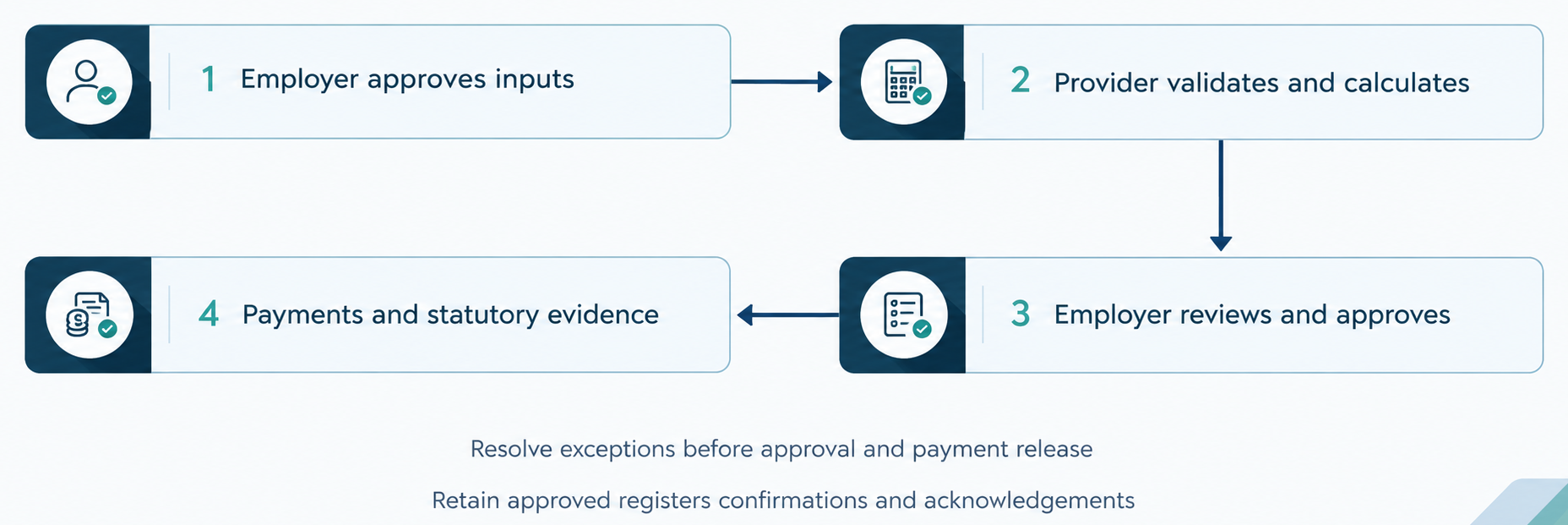
The monthly cycle starts before calculation. HR should approve joiners, exits, attendance, unpaid leave and compensation changes against a documented cutoff. Finance should confirm variable payments, recoveries and funding. A designated provider contact then validates the input file and flags missing information before processing.
Review should focus on exceptions: unexpected changes in net pay, new bank details, duplicate employees, negative pay, arrears and unusual deductions. Release the bank file only after an authorised approver signs off. Store payment confirmations and filing acknowledgements alongside the approved payroll register so that a completed run has a clear evidence trail.
Who remains responsible after outsourcing
The following is a recommended operating split for a processing engagement. It must be adapted to the contract and applicable law; it is not a legal allocation of liability.
|
Activity |
Employer role |
Provider role |
|---|---|---|
|
Employee and attendance inputs |
Own approve and submit |
Validate and query exceptions |
|
Salary policies and changes |
Decide and authorise |
Configure approved instructions |
|
Payroll calculations |
Review and approve |
Calculate reconcile and report |
|
Salary funding and release |
Fund and authorise |
Prepare bank file if contracted |
|
Statutory filings and remittances |
Oversee applicability funding and evidence |
Prepare submit or assist as agreed |
|
Employee queries |
Resolve policy decisions |
Explain calculations within scope |
|
Data security |
Govern access and vendor use |
Apply agreed controls and report incidents |
A provider may prepare a challan without depositing it, or submit a return without reconciling employee-level records. These are different deliverables. Require the agreement to state who prepares, approves, pays, files and checks each obligation. Payment of a provider invoice is not proof that a statutory remittance reached the authority.
Compliance requirements to review in India in 2026
Payroll compliance depends on the establishment, location, workforce and applicable notifications. Build an obligation register covering wage payments, social security, salary tax withholding, state levies and records. For each item, record applicability, owner, deadline, required approval and evidence of completion.
The Labour Ministry’s additional Labour Code FAQs distinguish statutory minimum wages from the definition of wages and explain that the revised wage definition applies from 21 November 2025. Review salary-component mapping carefully; a blanket instruction to make basic salary 50 percent of CTC is not an adequate legal assessment.
For PF and ESI, confirm establishment coverage, employee eligibility, contribution bases and current notifications before configuring payroll. Changes to employee status and work locations need review. Vauras provides PF and ESI consulting for businesses seeking help with these areas.
Salary TDS also needs a dated rule set. The Income Tax Department’s TDS transition guidance addresses the change to the Income Tax Act 2025 from 1 April 2026. Ask who updates the payroll configuration and validates the applicable provisions, forms and reporting period.
Professional tax, Labour Welfare Fund contributions and establishment-specific records require a location-based assessment where applicable. A national payroll template should not silently apply the same treatment across every state. Consider a separate compliance management review when your business adds locations or workforce categories.
Payroll outsourcing benefits and risks
|
Potential benefit |
Risk to assess |
Practical control |
|---|---|---|
|
Less repetitive internal work |
Poor input quality still causes rework |
Signed input checklist and cutoff |
|
Specialist processing support |
Scope gaps leave tasks undone |
Deliverable and responsibility matrix |
|
Better operational continuity |
Dependence on a single provider contact |
Backup processor and escalation path |
|
More consistent reporting |
Errors repeated through configuration |
Exception review and rule testing |
|
Easier expansion of processing capacity |
New locations add unpriced complexity |
Change control and location review |
Savings depend on your current cost and the scope purchased. Retained HR time, integrations and transition work still count. Do not treat a low processing fee as evidence of lower total cost or assume outsourcing eliminates penalties.
Protecting employee information
Payroll files contain salary, bank and identity information. Collect only the information needed for the agreed task, restrict access by role and use an approved transfer channel. Require documented controls for authentication, encryption, backups, access logs, subcontractors and incident escalation. These are procurement requirements to verify, not assumptions about every provider.
The government’s DPDP Rules announcement describes phased implementation. Check which provisions apply at the time of processing and plan for upcoming obligations. Include retention, deletion, lawful processing and return of records in the contract; an NDA alone does not establish adequate data governance.
What to put in the payroll SLA
Define the input deadline, draft delivery date, review window, payment-file handover and statutory evidence deadline. Add response and resolution targets for critical pay errors, treatment of late inputs and a named escalation route. Separate provider errors from changes requested after approval, including how each is charged.
Also agree how service performance will be measured. Examples include on-time draft delivery and corrections attributable to the provider. Define the denominator, exclusions and review period so an accuracy percentage has an auditable meaning.
Evaluate whether outsourcing fits your company
Start with one anonymised payroll cycle, a list of locations, the tasks your team performs and the problems you want to solve. A useful advisory discussion should identify which work to retain, which work to delegate and which compliance questions need specialist review.
Explore Vauras payroll outsourcing services and request an advisory discussion to assess your scope, approval controls and implementation priorities. Share headcount and operational complexity first; provide identifiable employee data only through an agreed secure channel.
Frequently Asked Questions
Can a small business outsource payroll?
Yes. The decision depends on internal capacity, compliance complexity and the provider’s minimum fee. A small employer may need specialist advice even when the number of payslips is low.
Does outsourcing transfer compliance liability?
Not automatically. A provider can carry out contracted tasks, but employer obligations and statutory exposure depend on applicable law and the arrangement. Contractual indemnities do not replace oversight.
Does the provider pay salaries from its own funds?
Do not assume so. In a processing arrangement the employer normally funds payroll and authorises release. Confirm bank access, funding arrangements and payment responsibilities in writing.
What information is needed to process payroll?
Usually approved employee records, compensation details, attendance or leave changes, joiners, exits and variable payments. The precise fields should follow the agreed scope and data-minimisation review.
Can we outsource only compliance support?
A narrower engagement may be appropriate if your internal team can process salaries. Specify whether you need advice, calculations, filings, reconciliation or remediation, because these involve different work.
How do we know the monthly run is complete?
Check the approved register, salary-payment confirmation, applicable statutory acknowledgements and reconciliations. Close outstanding exceptions with an owner and target date rather than marking the run complete after payslips alone.
General information reviewed on 23 October 2026. Applicability depends on your establishment, workforce, location and current notifications. Obtain advice for your particular facts before changing payroll treatment.