
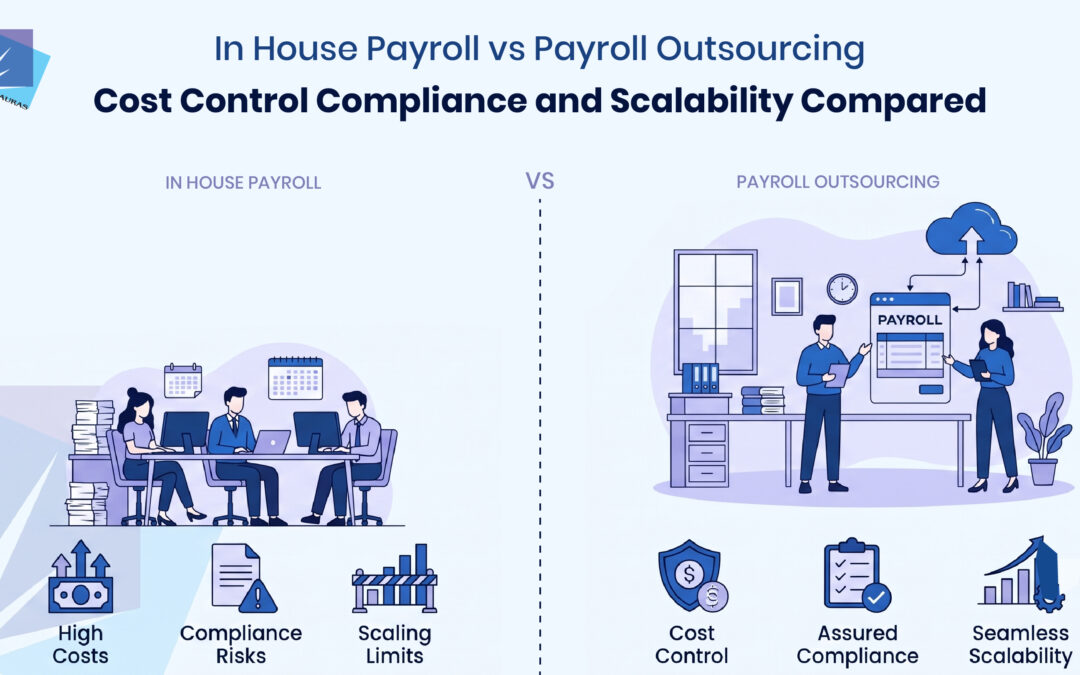
In-house payroll usually fits businesses with a capable internal team, reliable backup coverage and a need for frequent operational changes. Payroll outsourcing can fit businesses seeking specialist processing capacity, continuity or support across locations. A hybrid arrangement can retain policy decisions and approvals internally while delegating calculations or compliance tasks.
The better model is the one your business can govern and sustain at an acceptable total cost. Headcount matters, but it is not a sufficient decision rule. A small workforce across several states can create more work than a larger workforce with stable salaries in one location.
This comparison is for founders, CFOs and HR heads deciding whether to build capability internally, appoint a provider or buy focused advisory support. For the basic operating model, read our payroll outsourcing in India guide.
In house payroll versus outsourcing at a glance
|
Decision factor |
In house payroll |
Outsourced payroll |
|---|---|---|
|
Direct cost |
Staff software training and backup |
Service fee plus retained internal work |
|
Day to day control |
Internal team manages the processing queue |
Contracted schedule and change process |
|
Compliance expertise |
Built or purchased by the employer |
Available only within agreed scope |
|
Continuity |
Depends on internal coverage |
Depends on provider capacity and backup |
|
Scalability |
May require hiring or system changes |
May require repricing or scope expansion |
|
Data handling |
Internal access plus software vendors |
Additional external processing relationship |
|
Turnaround |
Flexible if staff are available |
Depends on cutoffs and exception SLAs |
|
Accountability |
Internal ownership can be direct |
Requires an explicit responsibility matrix |
Neither model guarantees accuracy or compliance. Both depend on reliable inputs, tested rules, independent review and evidence of completed payments and filings.
Compare total cost before comparing fees
An internal payroll team’s salary is only one cost component. Include the share of HR and finance time spent collecting inputs, checking results, resolving queries and maintaining compliance knowledge. Add software, integrations, training, leave cover and recruitment where relevant. Allocate shared staff costs rather than assigning their entire salary to payroll.
For outsourcing, include recurring provider charges, retained coordination and approval time, implementation, interfaces, exceptions and exit support. Salary payouts and statutory dues are obligations of the employer and should not be mistaken for the provider’s service fee.
A comparable model uses the same period and deliverables on both sides. For example, compare twelve months of processing, year-end support and agreed compliance work against twelve months of internal delivery of those same tasks. Use our payroll outsourcing pricing and hidden-cost guide to structure the external estimate.
A worked break even example
The figures below are hypothetical planning assumptions, not Indian market benchmarks, Vauras pricing or a promised saving. They show how retained work and implementation change the decision.
|
Cost item |
In house annual cost |
Outsourced annual cost |
|---|---|---|
|
Payroll staff time allocated to the function |
INR 4,80,000 |
Included in provider fee below |
|
Software training and backup |
INR 1,20,000 |
Included in assumed service scope |
|
Provider recurring fee |
Not applicable |
INR 3,00,000 |
|
Retained employer coordination and review |
Included in staff allocation above |
INR 1,20,000 |
|
First year implementation |
INR 0 assumed |
INR 60,000 |
|
First year total |
INR 6,00,000 |
INR 4,80,000 |
|
Later annual total before changes |
INR 6,00,000 |
INR 4,20,000 |
Under these assumptions, the first-year difference is INR 1,20,000. If extra interfaces, corrections or retained work cost more than that, the apparent first-year advantage disappears. Taxes, contractual increases and financing effects are excluded; include them where relevant to your decision.
A simple recurring-fee break-even ceiling is the comparable annual in-house cost minus retained annual employer cost minus first-year transition cost. Here it is INR 4,20,000 in year one. This is a ceiling for this scenario, not a recommended price or a headcount threshold.
Control means deciding what you retain
Outsourcing does not have to remove your authority over salary policy or payment release. Retain approval of compensation changes, bank-detail changes, unusual deductions and final payroll. Give a provider only the access needed for its work, with a clear audit trail.
The real trade-off is often speed of change. An internal team may respond quickly to a late incentive payment if it has spare capacity. A provider may treat the same change as an off-cycle run. Ask what happens after the cutoff and how urgent exceptions are authorised and charged.
Before buying a service, test a realistic exception. For example, ask the vendor to explain the workflow when an employee exits after draft payroll but before payment release. Look for a named decision owner, a revised register and a documented approval trail.
Compliance expertise requires evidence
An internal team needs a way to identify legal changes and translate them into payroll rules. A provider needs the same capability, plus a way to explain changes to the employer. Request sample rule-change records, review procedures and anonymised evidence packs rather than accepting a general compliance promise.
In 2026, Labour Ministry guidance and additional FAQs make salary-component mapping a relevant review area. The Income Tax Department’s transition guidance also matters for the tax provisions used in payroll. Ask either team to identify the applicable rule, effective date, configuration change and validation owner.
If processing works well but rule interpretation is uncertain, an advisory review may solve the problem without replacing the entire operating model. Vauras offers labour law advisory services and compliance management support; agree the specific review and execution scope before proceeding.
Business size scenarios and likely priorities
These examples are decision scenarios, not claims about Vauras clients or mandatory headcount cutoffs.
|
Illustrative business |
Main concern |
Model worth evaluating |
|---|---|---|
|
25 employees at one location |
Founder dependency and no backup |
Simple software with support or outsourcing |
|
120 employees across three states |
Location rules and workload peaks |
Outsourced processing with internal approvals |
|
400 employees with frequent variable pay |
Complex inputs and rapid exceptions |
Strong internal team or a tested hybrid |
|
1000 employees with established shared services |
Integration governance and specialist gaps |
Internal delivery with targeted advice or selective outsourcing |
A business with five employees can still need specialised compliance advice. A business with several hundred can run payroll effectively internally. Assess the volume of exceptions, number of entities, location changes and availability of skilled reviewers alongside headcount.
A practical decision path
Start by asking whether the current process produces accurate, timely payroll with dependable backup. If yes, identify the remaining gap before replacing it. A compliance review, software change or second reviewer may be enough.
If the process is unreliable, determine why. Missing attendance approvals are an internal data problem that outsourcing alone will not fix. A lack of processing capacity may suit outsourcing. Unclear legal treatment may require advisory support before either team can configure the system correctly.
Then test the preferred model against three gates: can it support your exceptions, can you retain necessary approvals, and can it provide usable completion evidence? If any answer is no, revise the scope or shortlist before comparing price.
Data security and continuity checks
In-house delivery still involves risk through software access, spreadsheets and staff turnover. Outsourcing adds an external processing relationship and potentially subcontractors. Evaluate access controls, secure transfers, incident handling, hosting arrangements and record exports in either model.
The government’s DPDP Rules announcement describes phased implementation. Treat privacy readiness as an operating requirement, with advice on provisions applicable to your situation and timing. Include data return, retention and deletion in the exit plan so switching providers does not strand employee records.
For continuity, identify the backup processor and approver, define an emergency run process and agree how records can be recovered. A provider’s business continuity statement is less useful than a tested explanation of how your next payroll would be delivered during an outage.
What to take into an outsourcing fit assessment
Prepare a list of legal entities, locations, headcount, payroll frequency, variable components and existing tools. Add the time your team spends each month and the exceptions that cause delays. Summarise unresolved compliance concerns separately from routine processing tasks.
Ask Vauras to discuss the retained roles, potential delegated scope and information needed for a proposal. Explore payroll outsourcing services and request a fit assessment discussion. A clear scope makes it easier to decide whether advice alone, selective support or broader outsourcing is appropriate.
Frequently Asked Questions
Is payroll outsourcing always cheaper than in house payroll ?
No. A capable internal team with suitable software may be economical. Compare equivalent scope and include retained review time, transition costs, support and exceptions in the outsourced total.
At what employee count should we outsource payroll?
There is no universal threshold. Location coverage, payroll complexity, internal capacity and risk exposure may matter more than headcount. Use scenarios based on your actual operating requirements.
Will outsourcing remove our HR payroll role?
Some tasks can move to a provider, but inputs, policies, employee decisions and approvals still need an internal owner. Redesign responsibilities before estimating staff capacity released.
Can we keep software and outsource processing?
Potentially. Confirm whether the provider supports your platform, what access is required, how licensing works and who owns integrations and configuration. Do not assume the existing system is compatible.
Is a hybrid payroll model useful?
It can be when the company wants to retain governance and employee relationships while buying specialist execution. Clearly separate retained tasks from delegated tasks to avoid duplicate work or gaps.
How should we evaluate a proposed switch?
Compare scope and annual cost, test exceptions, assess controls and plan a parallel validation run. Move only when opening balances, records, approval rights and statutory responsibilities are reconciled.
General information reviewed on 23 October 2026. Applicability depends on your establishment, workforce, location and current notifications. Obtain advice for your particular facts before changing payroll treatment.
Trackbacks/Pingbacks