
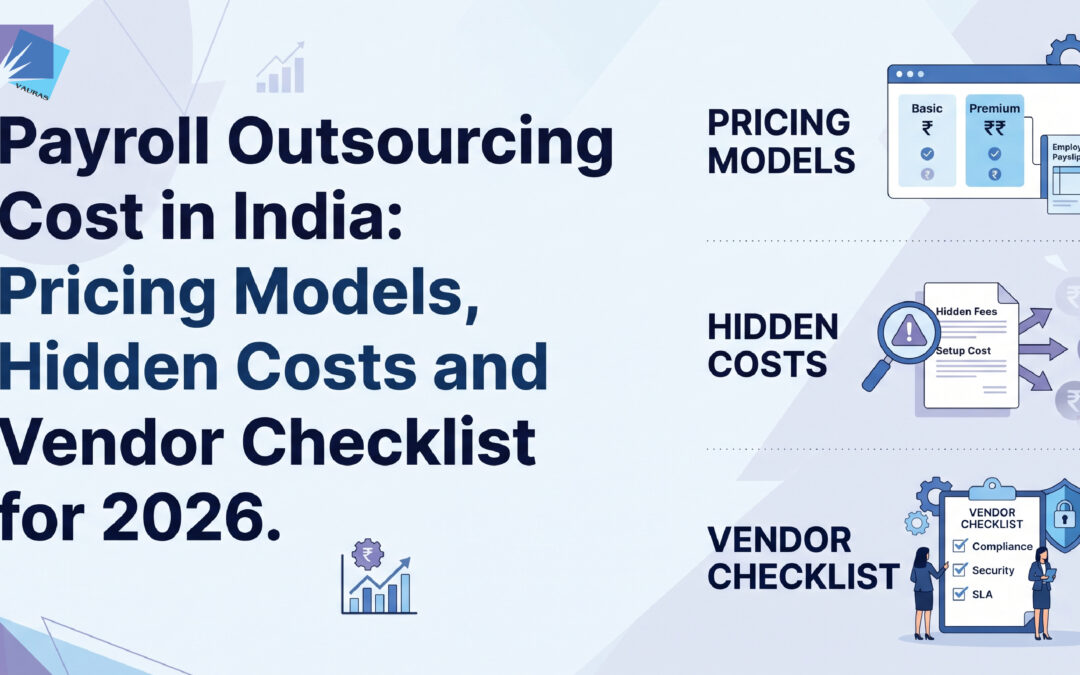
Payroll outsourcing cost in India depends on headcount, payroll complexity, locations, entities, compliance scope and support requirements. Providers may quote a per-employee-per-month fee, a monthly minimum, a retainer or a combination. A useful estimate separates implementation, recurring processing, statutory support and chargeable exceptions.
There is no single price that describes every outsourced payroll engagement. Compare the total cost of the same deliverables over the same period, including work your own team will still perform. The cheapest headline fee can become expensive if routine corrections, filings or employee support sit outside the package.
This guide helps finance heads, HR leaders and business owners prepare a quote request and assess commercial terms. For the delivery model, read how payroll outsourcing works in India. For the alternative business case, use the in-house payroll versus outsourcing comparison.
What determines your payroll outsourcing price
Headcount affects processing volume, but complexity often explains the difference between quotes. Multiple entities may require separate payroll registers, bank files, reconciliations and reporting. Multiple locations may require different state compliance treatment. Attendance integration, shift work, arrears and frequent variable payments add work even when employee numbers are unchanged.
Employee service requirements also matter. A provider answering individual payslip questions may price differently from one that supports only an HR coordinator. Ask whether the quote includes policy queries, historical corrections, notices or only explanations of current calculations.
Vauras has not published a tariff verified for this guide. The numerical examples below are hypothetical budgeting illustrations, not market ranges, Vauras rates or an offer. Request a written scope-based estimate before making a purchasing decision.
Common payroll outsourcing pricing models
|
Model |
How charges are calculated |
What to confirm |
|---|---|---|
|
PEPM |
Billable employees multiplied by monthly rate |
Meaning of billable employee and included runs |
|
Monthly minimum plus PEPM |
Greater of minimum fee or headcount charge |
Minimum commitment and idle periods |
|
Fixed monthly retainer |
Agreed recurring fee for a defined scope |
Volume bands and scope change triggers |
|
Base fee plus modules |
Core processing plus selected services |
Whether compliance and employee support cost extra |
|
Project or advisory fee |
Defined review migration or remediation work |
Deliverables assumptions and follow-up support |
PEPM means per employee per month. It does not necessarily mean one fixed charge for every employee on your HR system. Clarify treatment of joiners, leavers, inactive records, employees on unpaid leave and multiple runs. A pricing band should specify when growth changes the fee and whether rates adjust when headcount falls.
A sample quote structure
A usable proposal should show quantities, unit rates, recurring charges and one-time work. Ask providers to fill in the same structure so the comparison reflects scope rather than presentation.
|
Quote line |
Pricing basis |
Evidence or clarification to request |
|---|---|---|
|
Setup and migration |
One time |
Data mapping opening balances and validation |
|
Monthly payroll processing |
PEPM or retainer |
Registers payslips reports and run count |
|
Statutory support |
Included or separate |
Obligations locations and exact activities |
|
Integrations |
Setup plus maintenance if any |
Systems interfaces testing and ownership |
|
Off-cycle payroll |
Per run or included allowance |
Corrections versus requested extra runs |
|
Year-end support |
Included or annual fee |
Reconciliation forms employee support |
|
Advisory or remediation |
Project hourly or retainer |
Review scope and treatment of old periods |
|
Exit and data export |
Included or separate |
Formats timing assistance and deletion |
|
Taxes and annual escalation |
As applicable and contracted |
Tax basis renewal increase and notice |
For every compliance line, separate preparation, approval, filing, payment and reconciliation. A quote stating PF support may cover calculation while excluding registrations, employee record corrections or departmental notices. Ask for a deliverable list before deciding that two packages are equivalent.
A transparent monthly and annual cost example
Assume a company has 100 billable employees, a hypothetical PEPM fee of INR 150, a monthly minimum of INR 12,000 and setup of INR 20,000. Assume recurring processing includes the agreed standard run and that two requested extra runs cost INR 2,000 each during the year.
|
Calculation |
Illustrative amount |
|---|---|
|
Monthly PEPM charge of 100 × INR 150 |
INR 15,000 |
|
Monthly processing charge after minimum test |
INR 15,000 |
|
Annual recurring processing of INR 15,000 × 12 |
INR 1,80,000 |
|
Setup fee |
INR 20,000 |
|
Two extra runs |
INR 4,000 |
|
First year vendor fees before tax |
INR 2,04,000 |
|
Annual retained employer work assumed |
INR 60,000 |
|
First year operating cost before tax |
INR 2,64,000 |
Under these assumptions, the effective first-year operating cost is INR 220 per employee per month: INR 2,64,000 divided by 1,200 employee-months. The headline processing rate remains INR 150. Neither figure includes salary payouts, employer statutory contributions or taxes; those require separate budgeting.
At 60 employees, the same assumed PEPM rate produces INR 9,000, so the INR 12,000 monthly minimum would apply. That makes the effective recurring processing rate INR 200 per employee before extras. Minimum charges therefore matter especially when headcount fluctuates.
Hidden costs to check before signing
Check migration charges for incomplete historical data, opening-balance reconciliation and additional testing. A quote may assume clean employee records and standard salary structures; resolving inherited problems can become a separate project. Ask who owns cleanup and how change requests are approved.
Check interface costs for attendance, HRMS, accounting and banking. A spreadsheet export is different from a maintained integration. Confirm which party handles mapping changes, failed transfers and software upgrades after implementation.
Check monthly exceptions: late inputs, off-cycle payments, full-and-final settlements, arrears, revised reports and duplicate payslips. Distinguish provider-caused corrections from employer-requested changes so your company does not pay to repair an agreed service error.
Finally, check year-end and exit costs. Historical record exports, employee tax support, statutory corrections, audit assistance and termination handover may fall outside standard processing. Include expected costs in a first-year and renewal-year comparison, even where the final quote marks them optional.
Compliance scope can change the economics
A processing quote and a processing-plus-compliance quote are different purchases. Ask who assesses applicability, updates rules, prepares returns, arranges remittances and checks acknowledgements. Separately identify advisory work on salary structures, past-period issues and workforce categories.
The Labour Ministry employer handbook provides an official starting point for reviewing obligations under the Labour Codes. The Income Tax Department’s TDS guidance addresses the 2026 tax transition. Require a provider to confirm the applicable period and rule set instead of copying an old package description into a new agreement.
If your primary need is resolving uncertainty rather than replacing monthly payroll, ask about a focused compliance advisory engagement. For social security issues, explore Vauras PF and ESI consulting and specify whether the request concerns current processing, corrections or a notice.
Vendor checklist for a purchase decision
Use these questions in your shortlist discussion and require written answers in the proposal or agreement.
- Which entities, locations, employee categories and payroll frequencies does the price cover?
- What is a billable employee, and how do minimum fees and headcount bands work?
- Which outputs, filings, remittances and reconciliations are included each month?
- What are the input cutoff, approval window and urgent correction process?
- Which work is chargeable, and who approves extra fees before it begins?
- Who reviews rule changes, and what evidence supports configuration updates?
- What security controls, subcontractors and data-transfer arrangements will be used?
- What liability terms, service remedies, renewal increases and termination conditions apply?
- Can we export payroll records in usable formats, and what happens to retained data?
- What is the total first-year and renewal-year cost under our expected workload?
Request an anonymised sample payroll pack and a walkthrough of one exception. A provider should be able to explain the sequence from approved input to calculation, review and evidence. Evaluate clarity and control alongside commercial terms.
How to request a useful Vauras estimate
Share headcount by entity and location, payroll frequency, variable pay, monthly joiners and exits, current systems and the support you need. Include expected growth and any historical correction work. Start with an anonymised scope brief rather than emailing complete employee files.
Explore Vauras payroll outsourcing services and request a payroll outsourcing estimate. Ask for recurring processing, implementation, compliance support and advisory work as separate lines, with exclusions and retained employer responsibilities clearly stated. That creates a practical basis for deciding what to buy and what to keep internally.
Frequently Asked Questions
What is the payroll outsourcing cost per employee in India?
There is no universal rate. Your effective cost depends on the scope, monthly minimum, employee definition, complexity and extras. Ask for both the PEPM rate and the full annual estimate for your circumstances.
Are payroll outsourcing fees based on salary amounts?
Not necessarily. PEPM, retainers and base-plus-module arrangements are common commercial structures. If a provider quotes a percentage of payroll, clarify the payroll base and separate statutory funds from service charges.
Are setup and migration usually included?
They may be bundled or billed separately. Confirm data cleanup, opening balances, system configuration, integrations and parallel validation in writing. Included setup does not automatically mean all historical remediation is included.
Are statutory contributions part of the service fee?
Keep employer statutory dues and employee deductions separate from service charges. A provider may assist with payment or filing, but the proposal must explain funding, authorisation and proof of remittance.
Can a provider charge for payroll corrections?
The agreement should distinguish its own errors from late or changed employer instructions. Specify correction turnaround, fee treatment and escalation before the first run.
How do we compare two quotes fairly?
Give both vendors the same scope and employee assumptions, price expected exceptions and add retained employer effort. Compare first-year and renewal-year totals, then assess control, support and evidence quality alongside cost.
General information reviewed on 23 October 2026. Applicability depends on your establishment, workforce, location and current notifications. Obtain advice for your particular facts before changing payroll treatment.
Trackbacks/Pingbacks