
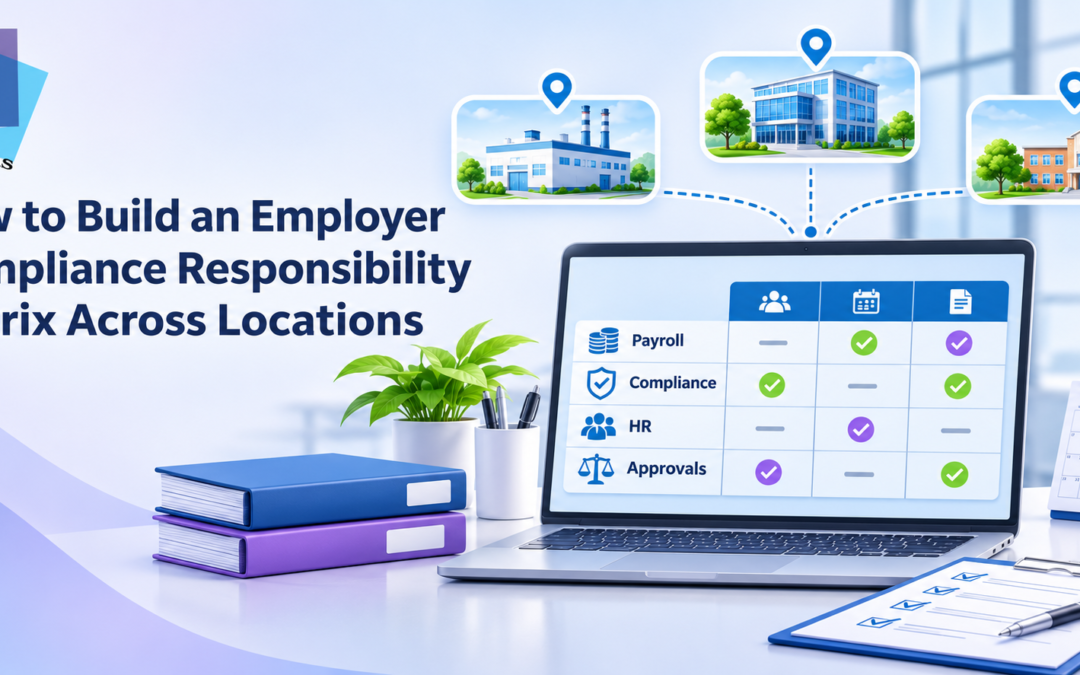
What is an employer compliance responsibility matrix?
An employer compliance responsibility matrix is a location-wise record that shows which employment and payroll obligations apply, who prepares each task, who checks it, when it is due and where proof is saved. For an Indian business with several branches, it turns payroll and statutory compliance management into a clear routine rather than a chain of emails.
Start with one row for each obligation at each establishment. Then assign a named owner and reviewer, check the applicable law, add a deadline based on the current official rule and keep a link to the filing or payment evidence. The matrix is a management tool: it does not replace the law, government portals or professional advice on applicability.
Why does responsibility become unclear across different locations?
A head office may process salaries centrally while factories, schools or branches supply attendance and joining details locally. The payroll team can calculate deductions, but it may not know about a new site, a contractor or a change in workforce strength. That gap is where tasks can get missed.
The scale of employee-compliance work is considerable. In its Annual Report 2024–25, ESIC reports 2,483,511 covered employers and 38,435,880 insured persons/family units as at 31 March 2025. These are national scheme figures, not figures for Vauras clients or evidence that every establishment must register.
Source: ESIC Annual Report 2024–25.
ADP’s Future of Pay in India 2025 research reported that 53% of surveyed organisations found statutory compliance management moderately challenging. The finding concerns ADP’s research respondents; it is not a measure of the share of all Indian employers experiencing compliance failure.
Source: ADP, Future of Pay in India 2025.
Which obligations should appear in the matrix?
Include only requirements confirmed as applicable to that employer and establishment. A useful starting inventory is below. Dates, thresholds and coverage need checking against the currently applicable central and state rules and notifications.
- Employee Provident Fund (EPF): registration coverage, employee details, contribution checks, remittance, returns and recordkeeping, where applicable.
- Employees’ State Insurance (ESI): covered employees, wage data, contribution reconciliation, filing and payment evidence, where applicable.
- Professional Tax and Labour Welfare Fund: state-specific registration, deductions, payment and returns where the law requires them.
- Wages and employment records: wage calculations, attendance, overtime, registers, leave and other records required for the establishment.
- Contract labour and site obligations: contractor records, licences, registers and principal-employer checks based on the actual arrangement.
- Notices and changes: new branch openings, legal updates, workforce changes, inspections and outstanding queries.
India’s labour-code framework and subordinate rules have changed over time. Do not rely on an older checklist for current applicability. Review the Ministry of Labour & Employment’s official labour-code updates and the relevant state notifications before approving a statutory calendar.
Official reference: Ministry of Labour & Employment—Labour Codes.
How do you build the responsibility matrix step by step?
1. List every establishment before listing the laws
Record the legal employer name, establishment address, state, site type, employee strength, contractor arrangements, registration numbers and the person responsible for site data. A remote office and a factory may need different entries even when they share a payroll team.
2. Confirm what applies to each site
Work with the HR lead and a qualified compliance reviewer to assess central, state and local requirements. Record the legal source, effective date and last-review date. Mark unclear items “needs legal confirmation” rather than treating them as compliant or not applicable.
3. Separate task ownership from final approval
For every item, name one person who prepares the data, another who reviews or authorises it and an escalation contact. A consultant may prepare filings, but an employer still needs an internal contact to approve correct inputs and provide records.
4. Add the trigger, deadline and evidence location
Some activities recur monthly or annually; others happen when an employee joins, a notice arrives or a site opens. Record the actual due date after checking the applicable official source, plus the portal acknowledgement, challan, register or approval trail that will prove completion.
5. Test the matrix against one payroll cycle
Take one recent wage month. Match attendance and the payroll register to contribution calculations, approvals, challans and payment records. Correct missing hand-offs before copying the process to every location.
What should a multi-location responsibility matrix look like?
Consider this fictional employer with a Kolkata head office, a Pune factory and a Jaipur school. The table illustrates ownership only; it does not assert that a particular statute applies to those sites. Replace the example items with obligations verified for your establishments.
| Site / example task | Prepares | Approves / checks | Evidence to retain | Trigger / due-date rule |
| Kolkata / PF contribution check | Payroll executive | Finance manager | Payroll-to-challan reconciliation | Monthly; verify current portal deadline |
| Pune / contractor record check | Plant HR | Compliance lead | Contractor register + verification note | At onboarding and periodic review |
| Jaipur / state-specific obligation review | School administrator | HR/compliance manager | Applicability note + official source | At setup and on rule changes |
| All sites / employee joiner updates | Local HR contact | Central payroll lead | Approved joiner list + portal status | Each joining / payroll cycle |
The important part is not the job title. It is having one accountable person, an independent check where practical and visible proof. A RACI model can help: Responsible prepares; Accountable approves; Consulted gives expert input; Informed receives the outcome. Avoid making five people jointly accountable for the same submission.
Who should own compliance when payroll is outsourced?
A service partner can handle agreed preparation, reconciliation and filing work, but the agreement should spell out exactly who provides employee inputs, who verifies them, who authorises payments, who submits returns and who responds to notices. Do not assume the phrase “end-to-end compliance” defines these boundaries.
A simple division is: local HR owns attendance, joiners, exits and site records; the central payroll team owns payroll input checks; finance owns approved funding and payment confirmation; the compliance reviewer checks applicability and filing evidence; management owns escalation and policy decisions. Adjust this to your actual staffing and written scope.
Vauras describes support for applicable PF, ESI and Professional Tax obligations, agreed challans and returns, contribution reconciliation and organising inspection records. Employers can discuss this scope through its
Payroll and Statutory compliance management services. A matrix makes it easier to agree which activities remain in-house and which are included in the engagement.
How do you keep the matrix updated?
- Review upcoming obligations at the start of each payroll cycle; flag missing location inputs before payroll is closed.
- Reconcile filings and payment acknowledgements after submission, not just the spreadsheet status.
- Recheck obligations when a site opens, headcount changes, contractors are added or an official notification changes.
- Keep a version history showing who approved each scope change and when.
- Limit access to employee information, retain only needed personal data and follow the organisation’s retention and security rules.
A useful monthly management view shows tasks due, tasks completed with evidence, pending approvals, outstanding notices and unclear applicability decisions. Colour-coded status helps, but a green cell is not proof of filing.
What should an employer ask before hiring compliance support?
Ask for a written location-wise scope and clarify the provider’s responsibilities. The following five questions are more useful than relying on a generic service description:
- Which establishments and obligations will be reviewed, and what is expressly excluded?
- Who validates applicability, registrations, thresholds and changes in state rules?
- What inputs must our staff provide, in which format and by what internal cut-off date?
- Who approves calculations and payments, and where are challans and acknowledgements stored?
- What happens when a deadline is at risk, a notice arrives or a reconciliation differs?
These questions also help compare in-house processes with third-party labour compliance services. Payroll software may track tasks and data, but organisations still need policy decisions, reliable inputs and an accountable reviewer.
Conclusion
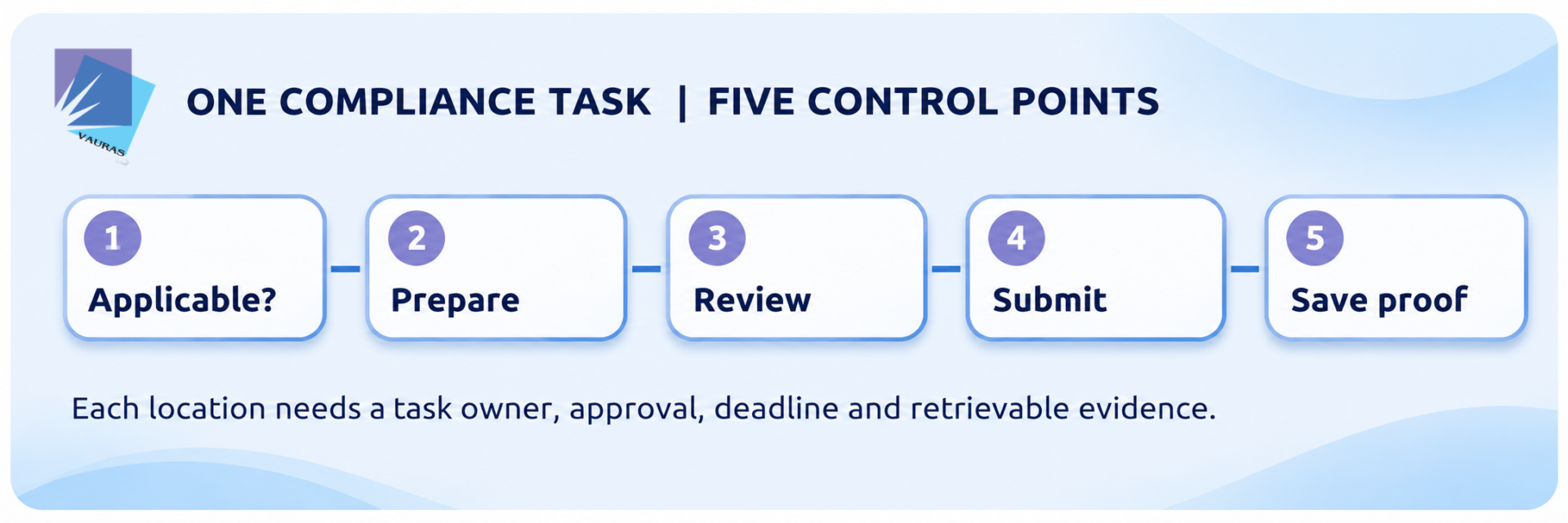
An effective employer compliance responsibility matrix answers five questions for every location: what applies, who prepares it, who approves it, when it is due and where the proof is stored. Start with the site inventory, validate applicability, test one payroll cycle and review the matrix whenever your workforce or obligations change.
For employers managing several sites, a scoped discussion with Vauras can help identify the payroll, PF/ESI and documentation activities that may need external support. Share your locations, establishment types, headcounts, outstanding notices and current workflow when requesting a review.
Next step: Discuss your compliance-management requirements with Vauras.
Frequently Asked Questions
1. Is one compliance matrix enough for all company branches?
Yes, one central workbook can be used, but it should contain separate entries for each establishment and obligation. The applicable rules and responsible people may differ by location.
2. Can a consultant be the owner of every task?
A consultant may prepare agreed filings, but internal staff still need to supply reliable inputs and authorise actions. Define the division in the written scope and matrix.
3. How often should a compliance responsibility matrix be reviewed?
Review recurring tasks during every payroll cycle and reassess applicability when a branch, workforce, contract arrangement or relevant law changes.
4. What proof should be stored after a PF or ESI filing?
Keep the reconciled payroll information, relevant contribution details, approved challans, payment proof and portal acknowledgements in line with applicable recordkeeping rules.
5. Does a responsibility matrix guarantee statutory compliance?
No. It improves oversight and accountability but cannot confirm legal applicability or prevent errors on its own. Current rules, correct data and review remain essential.
References and source notes
- Employees’ State Insurance Corporation, Annual Report 2024–25 (status at 31 March 2025)
- ADP India, Future of Pay in India 2025 (research respondent figures)
- Ministry of Labour & Employment, Labour Codes / official notifications
- Vauras, Compliance Management Services (service-scope evidence)
- ADP India, Payroll Compliance (comparison reviewed)
- TMF Group, India service overview (comparison reviewed)
- greytHR, Payroll-related Statutory Compliances (comparison reviewed)