
Moving to an external payroll provider should start with a written scope, clean employee records, reconciled opening balances, and clear approval responsibilities. Before the first live payment, test the new calculations against an approved payroll period, explain every difference, and agree who will authorise salaries and complete each statutory task.
For an SME comparing payroll outsourcing services in India, the transition plan deserves as much attention as the monthly fee. A provider needs reliable inputs and decisions from your team. Signing a contract alone does not make the next salary cycle ready.
This checklist is for business owners, HR managers, and finance teams moving an existing Indian employee payroll to a provider. It focuses on implementation after selection. If you are still evaluating suppliers, start with Vauras’s guide to choosing a payroll management company in India.
What should a payroll outsourcing transition checklist include
Use these ten checkpoints to decide whether your payroll is ready to move:
- Confirm the employment model and service scope.
- Appoint an internal owner and named backup.
- Agree the first live month and monthly cutoffs.
- Validate employee data and salary rules.
- Reconcile opening and year to date balances.
- Map compliance obligations and responsibility for evidence.
- Set secure access and data transfer controls.
- Run and reconcile a parallel payroll.
- Approve payment arrangements and employee communication.
- Review the first live cycle and close the handover.
Do not treat this as a document collection exercise. Each checkpoint needs an owner, a due date, and evidence that it is complete. Keep unresolved issues in one shared tracker so that nothing disappears between the outgoing team and the new provider.
1 Confirm what is being outsourced
Separate payroll processing from employment arrangements
Under a payroll processing arrangement, your business generally remains the employer while the provider performs agreed payroll tasks. Do not assume the employees move to another organisation simply because payroll is outsourced.
Third party payroll services can involve a different employment arrangement. Before accepting one, confirm whose name appears on employment contracts, payslips, and statutory registrations. Record who handles employment changes, benefits, grievances, and separation obligations.
You may also encounter the search term employee on record. Ask whether the provider means an employer of record arrangement, and request a clear explanation of the legal employer and contractual responsibilities. A service label is not enough to establish the employment relationship.
Turn broad promises into deliverables
Agree whether the scope includes salary calculations, payslips, bank files, attendance imports, reimbursements, arrears, full and final settlements, employee queries, statutory submissions, and accounting reports. Identify one time migration work and historical corrections separately.
Vauras’s payroll outsourcing services page describes payroll, third party payroll, and contractor payroll support. Use that page to start a scope discussion, then obtain a proposal for your actual workforce and operating model. Do not assume every task is included in a standard monthly fee.
2 Assign owners and agree the payroll calendar
Choose one internal transition owner who can obtain information from HR, finance, operations, and the outgoing provider. Appoint a backup with access to the handover records.
Put the following dates into the calendar:
- Employee master and salary change cutoff.
- Attendance, overtime, and variable pay submission.
- Draft payroll delivery and query resolution.
- Final review and payment approval.
- Bank upload, authorisation, and funding.
- Payslip release and applicable compliance tasks.
Allow time between approval and payday for banking cutoffs, holidays, and rejected transactions. The provider’s payroll delivery date and the bank’s payment date are different milestones.
Identify who can approve an input received after cutoff. Otherwise, a late incentive or attendance correction may become an unrecorded change to an already approved payroll.
3 Clean employee data before migration
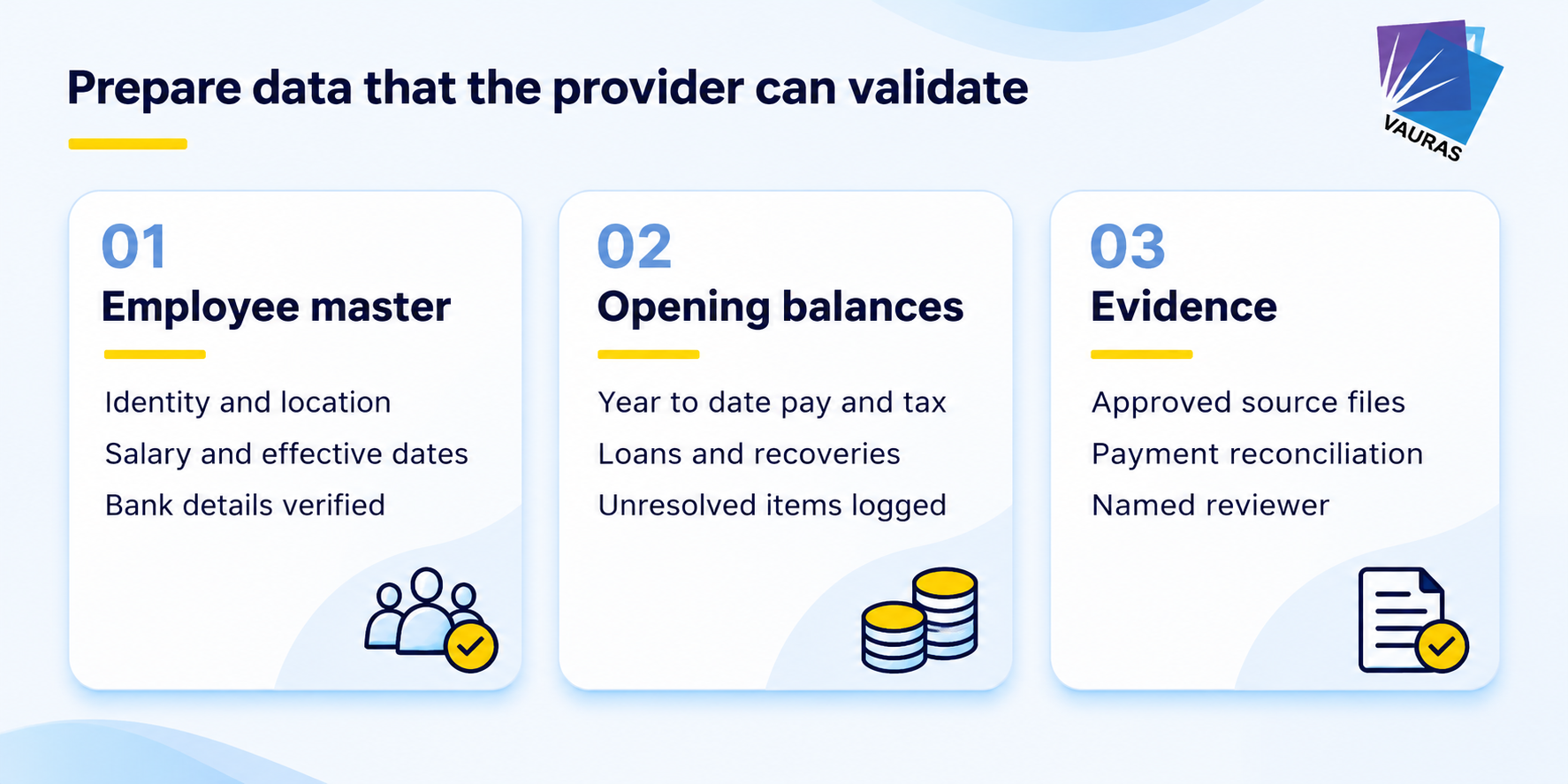
Create a controlled employee master with a unique employee ID. Ask the provider for its import template and mandatory fields before exporting large files.
Employee information to validate
- Legal name, joining date, employment status, entity, and work location.
- Bank account details and payment method.
- PAN and relevant payroll tax information.
- UAN and ESIC identifiers where applicable.
- Salary components, effective dates, and approved revisions.
- Attendance rules, leave balances, and loss of pay treatment.
- Loans, advances, recoveries, and recurring deductions.
- Approved benefits, reimbursements, and variable pay rules.
Check duplicate IDs, inactive employees still marked active, missing bank details, and salary revisions without effective dates. Validate bank changes through an agreed verification process rather than accepting an unverified email request.
Transfer only the information needed for the agreed service. Restrict access to identity documents and bank details. A complete migration file should not become a payroll spreadsheet available to the whole business.
4 Reconcile opening balances and historical records
A midyear switch needs more than the previous month’s net salary. The incoming provider must understand the cumulative position for the relevant tax year and the obligations still outstanding.
Prepare year to date earnings, tax deducted, exemptions and declarations used, contribution records, outstanding loans, recoveries, leave balances, and relevant previous employment income information. Record pending settlements, arrears, and corrections separately.
Reconcile three views: payroll registers, accounting records, and payment or filing evidence. If they differ, document the cause and agree who will correct it. Importing a historical mismatch simply moves the problem into a new system.
Keep an approved opening balance file with a version date. Have finance sign off the totals and HR confirm employee records. Where figures cannot yet be resolved, keep an exception with an owner and resolution deadline rather than silently treating the amount as zero.
5 Map compliance to the actual workforce
Create an applicability register by legal entity, establishment, location, and employee category. Review PF, ESIC, salary tax withholding, Professional Tax, Labour Welfare Fund, and other relevant wage or employment obligations. They do not all apply in the same way to every business or employee.
For each applicable task, record the calculation basis, due date, preparer, reviewer, person responsible for payment or filing, and evidence to retain. Decide who handles notices, corrections, and periods before the takeover date.
Check current rules rather than copying old settings
India’s four Labour Codes were made effective from 21 November 2025. Payroll configuration should be checked against the provisions, rules, schemes, and notifications applicable to your establishment and state at the time of transition. The Ministry of Labour and Employment’s Labour Codes resources provide an official starting point.
The Income Tax Department’s TDS compliance FAQs explain that salary withholding for Tax Year 2026–27 falls under section 392(1) of the Income-tax Act, 2025. If you change providers during the year, preserve cumulative salary and withholding information so the new provider can continue the computation correctly.
Avoid importing an old compliance calendar without checking it. Outsourcing tasks does not, by itself, remove the employer’s statutory responsibilities. Where broader support is needed, discuss the scope of Vauras compliance management services alongside payroll processing.
6 Agree data security and exit arrangements
Salary files contain sensitive personal and financial information. Agree the transfer channel before sending the first employee file.
- Use an approved secure portal or encrypted transfer method.
- Give named users access according to their role.
- Enable multifactor authentication where supported.
- Record who can export data or change payment details.
- Agree confidentiality, incident escalation, retention, and deletion terms.
- Identify any subcontractors or systems that will process the data.
Also agree how you can retrieve employee masters, payroll registers, payslips, calculation reports, filing evidence, and audit logs when the service ends. Specify export formats, turnaround times, support charges, and authorised access during an exit.
Do not cancel the outgoing provider’s access before the required handover is complete. Revoke unnecessary access promptly after completion and retain company control over critical accounts and authorisations.
7 Run a parallel payroll and explain every difference
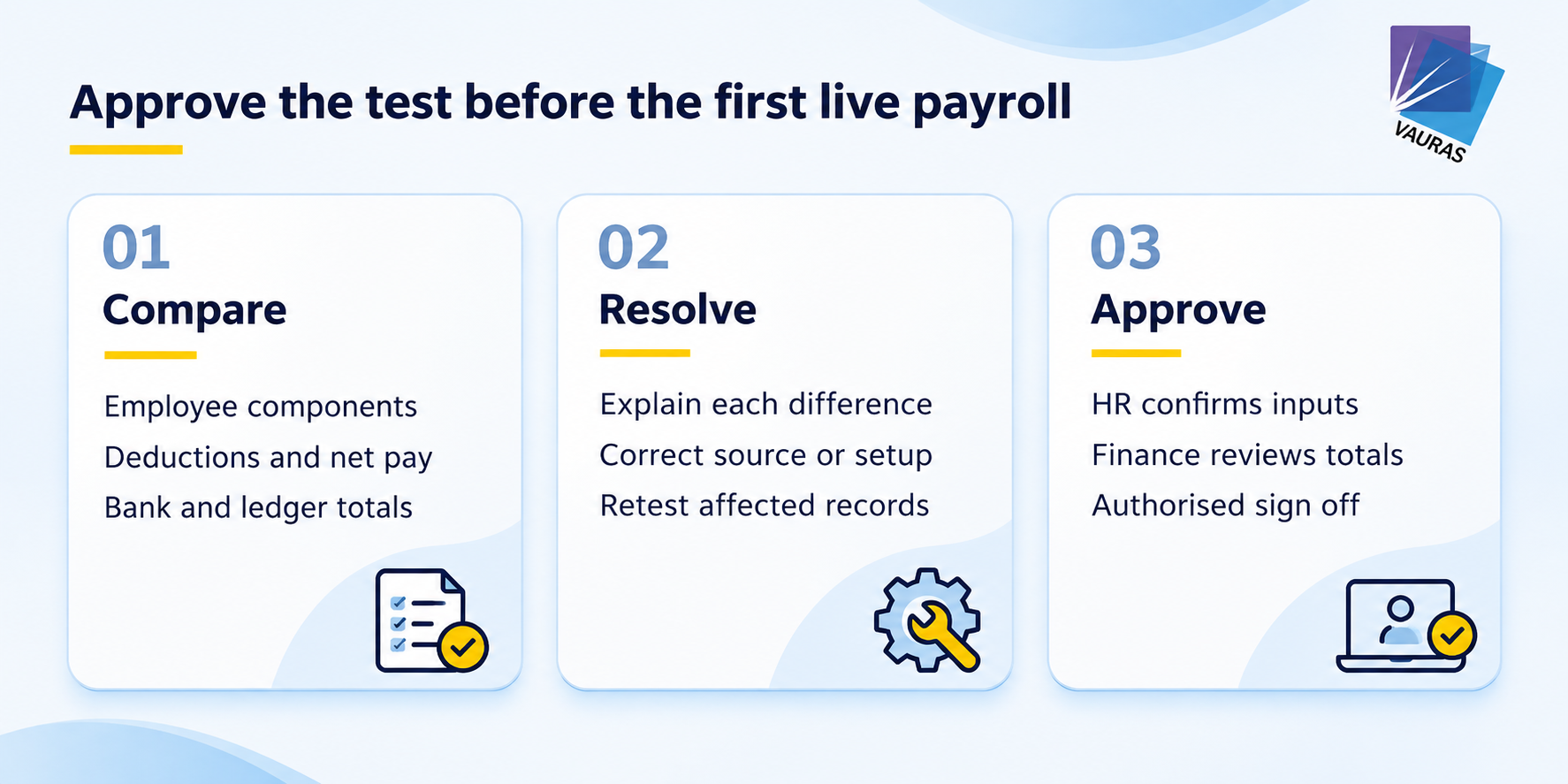
A parallel run means calculating an agreed payroll period in the new setup and comparing it with the approved reference payroll before using the new result for live payments.
Compare each employee’s earnings, deductions, contributions, tax, and net pay. Then reconcile company totals, the bank file total, and the accounting output. A matching net salary alone can hide errors in individual components.
Include cases that test the rules
Use a normal salaried employee, a new joiner, an employee with loss of pay, someone receiving arrears or an incentive, an employee with a recovery, and a leaver where relevant. Test attendance imports, payslip access, and full and final calculations if these are in scope.
Record each difference, its cause, the correction, and the reviewer. Do not assume the old payroll is always correct: a valid rule correction can create an expected difference. Retest the affected records and obtain written acceptance.
At least one complete parallel cycle is a useful planning baseline, not a legal minimum or a promise that every payroll is ready after one test. Add further testing if material exceptions remain.
8 Approve the first live payment and inform employees
Keep salary funding, file preparation, and payment authorisation clear. Your agreement should say whether the provider prepares a bank file, uploads it, or supports another payment arrangement. Confirm who actually releases funds.
Before payment, check active headcount, net pay totals, duplicate records, account changes, and any employees placed on hold. Confirm funding and backup approvers. Define the response to a rejected transfer so that a corrected payment does not become a duplicate payment.
Tell employees when the change begins, how they will receive payslips, where to submit payroll queries, and how to report an incorrect payment. Explain any new portal access and declaration process. Keep the communication practical; employees mainly need to know what they should do and whom to contact.
9 Add separate controls for contractor payroll management
If your workforce includes contractor supplied staff, keep that population distinct from your direct employees. Record the contractor, deployment location, attendance approver, wage details, and relevant contribution evidence.
Contractor payroll management should include an agreed method for checking that records relate to the people deployed at your establishment. A consolidated payment receipt may not, on its own, resolve every employee level mismatch.
EPFO’s principal employer guidance on contractor compliance stresses verification of contractor PF compliance and principal employer responsibility. It is historical guidance; confirm the current applicable framework and portal requirements before setting your controls. Do not treat a contractor’s separate registration as a reason to stop checking compliance.
10 Review the first cycle before closing the transition
After payday, reconcile successful and failed payments, issue payslips, and close employee queries. Track applicable filings and remittances until evidence is available; a completed salary transfer does not mean the whole cycle is finished.
Review delivery against the agreed calendar. Record recurring input problems, unexpected charges, unresolved calculations, and support delays. Assign each issue an owner and a deadline before the next cutoff.
Close the transition only when opening balances are accepted, access is correct, material test issues are resolved, and the first cycle’s outputs are accounted for. Keep one approved handover record so future staff can understand what changed and why.
An illustrative transition for a 60 employee SME
Consider a fictional business with 60 employees across two states. It is moving from spreadsheets to an external provider while remaining the legal employer. It has fixed salaries, monthly incentives, and a small number of employee advances.
During preparation, HR discovers that three salary revisions lack effective dates. Finance finds an advance balance that differs from the payroll sheet. Both issues are resolved before the approved migration file is issued.
The parallel run then shows different net pay for two employees. One difference comes from an incorrect attendance import; the other comes from missing cumulative tax information. The team corrects both inputs and retests before approving the live file.
An illustrative sequence is to use the first week for scope and ownership, the second for data and reconciliation, the third for testing, and the fourth for approval and employee communication. This is a planning example, not a guaranteed implementation period. Historical gaps, multiple entities, integrations, or complex employment arrangements can require more time.
The useful lesson is simple: a calendar becomes credible only when each stage has evidence of completion.
Conclusion
A successful payroll handover depends on clear scope, reliable data, tested calculations, and retained oversight. Keep the employer’s approval responsibilities visible and carry unresolved items forward in a controlled tracker.
If you are comparing payroll outsourcing companies in India, ask each shortlisted provider to explain the transition against your own employee records and payroll calendar. A detailed handover discussion is more useful than a general promise of a smooth migration.
Planning to outsource payroll? Explore Vauras payroll outsourcing services in India and share your employee count, locations, current process, required services, and intended first live month. Ask for a written scope and transition plan covering responsibilities, testing, and first cycle support.
Frequently Asked Questions
What documents should an SME prepare before outsourcing payroll
Prepare the employee master, salary structures, attendance and leave rules, approved revisions, previous payroll registers, year to date balances, tax information, relevant contribution and filing evidence, outstanding recoveries, and pending settlements. Use the provider’s agreed template and transfer the information securely.
Can an Indian SME change payroll providers during the year
Yes, a midyear change can be planned. Reconcile cumulative earnings, deductions, tax, contributions, and outstanding balances before migration. Agree who handles earlier periods and corrections so the change does not create gaps or duplicate work.
How long does a payroll outsourcing transition take
There is no single timeline for every SME. Data quality, headcount, entities, locations, integrations, and historical corrections affect the work. Agree a schedule after the provider reviews the scope, and allow enough time for reconciliation, testing, and approval before payday.
Does outsourcing payroll transfer employees to the provider
Payroll processing alone does not automatically transfer employment. Third party employment or employer of record arrangements require separate contractual and legal review. Confirm the legal employer, employment documents, and statutory responsibilities before proceeding.
Who should approve the first outsourced payroll
The employer should appoint authorised HR and finance reviewers according to its approval policy. HR validates employee changes and attendance; finance checks totals, funding, and payment controls. Obtain final approval before salary release and retain the supporting records.
References
- Government announcement on the four Labour Codes
- Ministry of Labour and Employment Labour Codes resources
- Income Tax Department TDS compliance FAQs
- EPFO historical circular on contractor compliance
Official resources reviewed on 10 November 2026. This is an operational checklist; applicability and current requirements need review for the employer’s circumstances. The SME example is fictional.