
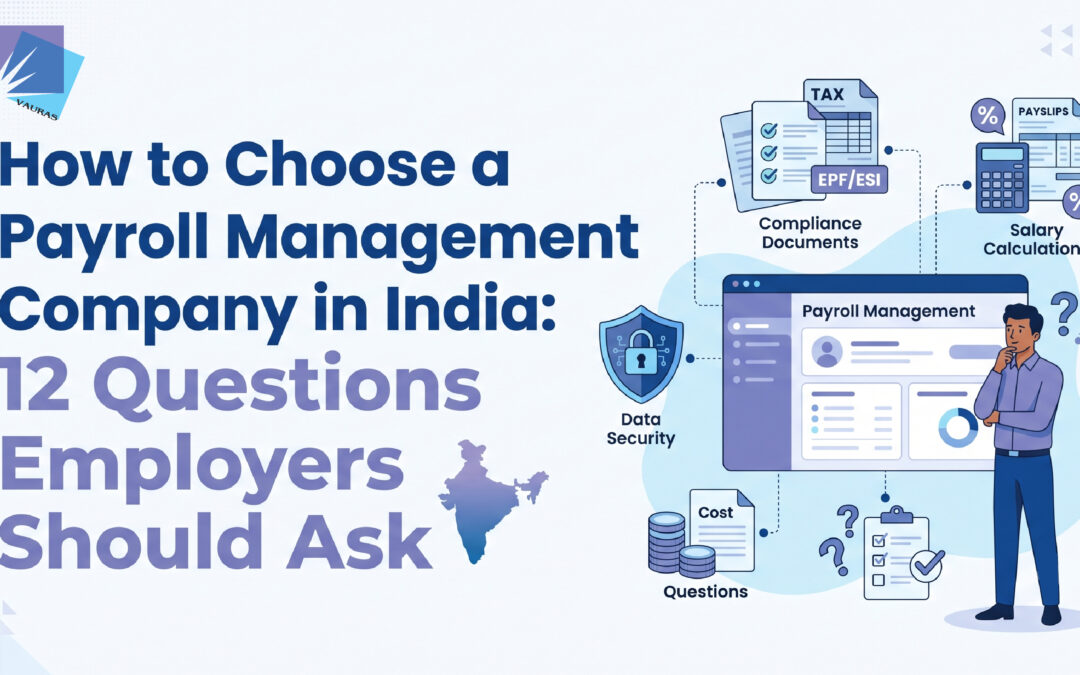
12 Questions Employers Should Ask
Choose a payroll management company in India by testing its compliance scope, calculation controls, service commitments, data handling and implementation process against your actual workforce. Ask for sample outputs and written responsibilities before comparing fees. The strongest proposal explains who supplies inputs, who checks payroll, who approves payments and who delivers statutory evidence.
A payroll provider can calculate salaries correctly and still leave your HR team chasing attendance corrections, employee queries or filing acknowledgements. These gaps usually become visible after the contract starts. A structured selection process helps employers uncover them while there is still time to change the scope.
This guide is for business owners, HR leaders and finance teams evaluating a managed payroll provider for employees who remain on their organisation’s payroll. If you first need an overview of the monthly workflow, read Vauras’s payroll management process and compliance guide.
Define the operating model before comparing providers
Payroll software supplies a platform. Your team may still need to maintain records, validate inputs, configure deductions and complete filings. Managed payroll adds an agreed service around those tasks, with responsibilities divided between the employer and provider.
Employment arrangements require a separate check. Some providers use “payroll outsourcing” to mean processing a client’s payroll. Vauras describes its payroll process management as managing payroll activities while employees remain on the client’s payroll; its third-party payroll offering uses a different employment arrangement. Confirm the legal employer, employment documents and statutory registrations rather than relying on a service label.
When comparing Vauras payroll management services, specify that you are evaluating payroll processing for your existing employees. This keeps the proposal focused on the right service and avoids mixing processing fees with third-party employment costs.
Prepare a short brief for every shortlisted company
Give each provider the same starting information: employee count, legal entities, work locations, salary structures, attendance system, pay date, variable-pay frequency and current problems. Include expected hiring, payroll corrections, open notices and historical reconciliation work.
A business with 80 employees in one location and fixed monthly salaries needs a different workflow from an 80-person business with several state locations, shift attendance and frequent incentives. Headcount alone does not define complexity. Ask the provider to state the assumptions used in its proposal so that later changes can be priced and managed openly.
Question 1 What exactly is included in the monthly service
Request a written scope covering employee master maintenance, attendance import, gross-to-net calculations, payslips, payment files and reporting. Then ask separately about arrears, incentives, reimbursements, full and final settlements and employee queries.
“End-to-end payroll” is too broad to be an acceptance criterion. A provider may calculate PF or ESIC deductions but exclude portal submissions or reconciliation. It may supply a bank file while your finance team must upload and authorise it. Record these boundaries before discussing price.
Evidence to request: a sample monthly deliverables list with inclusions, exclusions, employer dependencies and separately charged activities.
Question 2 How will you map compliance to our workforce
Ask how the provider identifies applicable payroll obligations by establishment, employee category and location. The discussion should cover PF, ESIC, salary withholding, Professional Tax and Labour Welfare Fund where applicable, without assuming that every obligation applies to every employee.
Use a practical test: explain that your company is opening a branch in another state and ask what information the provider needs before configuring payroll there. A useful response separates applicability assessment, registrations, calculation changes and filing responsibilities.
The Ministry of Labour and Employment’s employer compliance handbook explains the Labour Code framework and primarily addresses establishments within the Central Government sphere. Your provider should identify the relevant government and applicable rules for your business. For wider establishment requirements, discuss statutory compliance management separately from salary processing.
Question 3 How do you validate salaries before release
Ask for the control sequence between receiving inputs and producing the approved payroll. Useful checks include missing bank details, duplicate employees, unusual net-pay changes, unexpected deductions, duplicate incentives and inconsistencies between joining or exit dates and attendance.
Find out whether another person reviews the calculation and whether HR receives an exception report before approval. Ask how corrected inputs are versioned so an old spreadsheet cannot accidentally replace a newer approved file.
During a demonstration, introduce a duplicate incentive and an incorrect loss-of-pay entry. Ask the team to show how it identifies, corrects and records the changes. This provides better evidence than an unsupported promise of perfect accuracy.
Question 4 What payroll service levels will you commit to
A service level agreement, or SLA, should define deadlines, dependencies and escalation. Agree when inputs close, when draft payroll arrives, how long the employer has to approve it and when final outputs are delivered. The schedule must leave time for checks before the agreed pay date and applicable statutory timelines.
Distinguish response time from resolution time. An acknowledgement does not resolve an incorrect salary. Ask what happens when an error is found after approval, when inputs are late or when a statutory portal is unavailable.
Evidence to request: a calendar and issue-priority matrix that names responsible people, correction deadlines and escalation routes. Any financial remedy or liability allocation must appear in the negotiated agreement.
Question 5 Who owns each approval and statutory action
The employer should understand the workflow even when a provider performs it. Agree who approves salary changes, validates attendance, authorises payments and provides funds for statutory remittances. Require filing acknowledgements and reconciliation evidence rather than a verbal confirmation that a task is complete.
For PF workflows, the EPFO employer portal provides employer access and ECR-related references. Ask the provider to explain how payroll records connect to submissions and payment evidence, including how differences are investigated.
Appointing a processor does not, by itself, change who employs your staff. Statutory responsibility follows the applicable law and employment arrangement; contractual task allocation must be reviewed on that basis.
| Activity | Employer control | Provider deliverable to agree |
|---|---|---|
| Employee and salary changes | Supply authorised changes | Validate and update the master |
| Attendance and variable pay | Approve the inputs | Import inputs and identify exceptions |
| Payroll release | Approve final amounts and funding | Deliver checked payroll and payment file |
| Statutory submissions | Confirm responsibility and authorisation | Prepare or submit agreed filings with evidence |
| Reconciliation | Review unresolved differences | Supply matching reports and correction status |
Question 6 How is employee data protected
Payroll records contain identity details, bank information and compensation data. Ask who can access them, how permissions are granted and removed, where information is stored and whether transfers and stored files are encrypted.
Request details of subcontractors, backup arrangements, incident notification and data deletion at contract end. If the company cites a security certification, verify the certificate’s validity and whether its scope covers the service you are buying. A platform’s certification does not automatically cover every service process around it.
Use anonymised records during initial demonstrations. Before sharing live data, agree confidentiality, authorised processing, access controls and the applicable data-protection requirements in the contract.
Question 7 Can the provider work with our attendance and finance systems
Ask whether the proposal assumes a manual spreadsheet, a standard import, an API connection or a customised integration. These options require different implementation effort. Confirm which party builds and maintains the connection, including responsibility when either system changes.
Test one complete path: attendance enters payroll, approved salary changes are applied, payroll is calculated and a finance posting is produced. Check the handling of cost centres, leave adjustments and rejected records. A successful file upload is insufficient if the imported values are wrong.
Evidence to request: supported formats, field mapping, validation rules, failure alerts and any integration charges.
Question 8 How will migration and parallel payroll work
Moving providers requires more than uploading employee names. Opening balances, year-to-date earnings and deductions, leave balances, salary components and statutory identifiers may need validation. Historical differences should be logged so they are not silently carried forward.
Ask for a migration plan with named owners and acceptance criteria. Run parallel payroll for an agreed period or representative set of cases, comparing earnings, deductions, net pay and statutory outputs. Resolve significant differences before the new process goes live.
Request a fallback plan for an unsuccessful migration. Your agreement should explain how salary processing continues if data quality or integration problems delay launch.
Question 9 Who resolves employee questions and urgent errors
Ask whether employee support is included and what it covers. Payslip explanations, tax declarations, bank changes and PF or ESIC questions need different expertise. Confirm whether employees contact the provider directly or route queries through HR.
Review a sample issue register showing ownership, response, correction and closure. Also ask who covers the account manager’s absence. A service depending on one person creates avoidable continuity problems.
Where specialist assistance is needed, Vauras’s PF and ESI consultancy service is a relevant scope discussion. Confirm which activities are part of the payroll fee and which require a separate engagement.
Question 10 What reports and audit evidence will we receive
Ask for anonymised examples of the payroll register, variance report, statutory reconciliation and finance summary. Check whether reports match your legal entities and cost centres and whether they can be exported in usable formats.
An audit trail should show the source input, subsequent change, approving person and final output. Clarify how long records remain accessible and how evidence will be supplied during an audit or inspection. Reports that look attractive but cannot be reconciled to payroll are of limited use to finance.
Question 11 How do you implement regulatory changes
Ask how the provider monitors official updates, decides applicability and tests configuration changes before using them in live payroll. Request an example of a change log and client communication, with confidential information removed.
The Labour Ministry’s additional Labour Code FAQs dated 16 March 2026 clarify the wage definition and treatment of remuneration components. A provider should explain its assessment rather than apply a blanket “basic salary equals 50% of CTC” shortcut. Use Vauras’s Labour Codes employer checklist to frame the broader readiness discussion.
Question 12 What will the full cost and exit terms be
Compare the recurring fee, minimum bill, implementation, integrations and separately priced work. Ask how employees are counted for billing and how charges change when headcount rises or falls. Record fees for additional runs, corrections, notices, historical work and year-end support.
Then check contract duration, renewal increases, termination notice and data handover. Require usable employee records, payroll history and reconciliation status at exit. A low monthly fee may become expensive if ordinary changes or the eventual handover trigger unanticipated charges.
Evaluate price after the service has passed your essential scope and control requirements. This lets you compare equivalent proposals instead of treating every per-employee figure as the same product.
Use an evidence based vendor scorecard
The following weights are a suggested procurement tool, not an industry certification. Adjust them to your risks. Score each area from 0 to 5, where 0 means no evidence and 5 means demonstrated capability supported by a written commitment. Calculate each weighted score as rating divided by 5 multiplied by weight.
| Evaluation area | Suggested weight | Evidence to review |
|---|---|---|
| Compliance scope and change management | 25 | Applicability mapping and change log |
| Payroll accuracy controls | 20 | Exception report and demonstration |
| Service levels and support | 15 | Calendar and escalation matrix |
| Data protection and continuity | 15 | Access controls and recovery process |
| Migration and integrations | 10 | Mapping and parallel-run plan |
| Reporting and audit evidence | 10 | Reconciled sample reports |
| Commercial clarity and exit | 5 | Full quote and handover terms |
A high aggregate score should not override a critical failure. Treat an unwillingness to define filing responsibility, unsafe data sharing or an unworkable payroll calendar as a reason to resolve the issue before proceeding.
Red flags that deserve a second discussion
Be cautious when a provider promises zero errors without showing checks, describes all compliance as included without listing obligations, or refuses to provide sample deliverables. Other warning signs include unclear payment authority, no backup support, undefined integration costs and an exit process that restricts access to your own records.
For example, a hypothetical 120-person company with employees across several states may prefer a proposal that documents location mapping and reconciliation over a cheaper proposal that only produces payslips. This is a procurement example, not a Vauras client result. The decision turns on the work included and the employer’s remaining workload.
Discuss your payroll requirements with Vauras
Vauras is based in Kolkata and presents payroll management, PF and ESIC support, and statutory compliance services on its website. For payroll process management, it describes an arrangement in which employees remain on the client’s payroll. These are useful starting points for a scope discussion; your proposal should still specify deliverables, location coverage, service levels and fees.
Share your employee count, establishments, attendance process, pay calendar and current reconciliation issues. Contact Vauras for a payroll requirements discussion and compare the resulting proposal against the 12 questions above.
Frequently Asked Questions About the New Labour Codes 2026
What is the difference between payroll software and managed payroll ?
Software provides the tools to run payroll. Managed payroll includes an agreed level of operational support, such as input validation, calculation, reporting or filings. Ask who actually performs each task because product and service packages vary.
Can we retain payment control with a payroll management company?
Yes, the workflow can reserve final payroll approval and payment authorisation for your team. Confirm the banking process, account permissions and funding responsibilities in writing. Do not assume that providing a bank file authorises the provider to release funds.
How many payroll providers should we shortlist?
Choose a manageable shortlist that lets you compare proposals in depth. Two or three credible proposals can be sufficient when each provider receives the same brief. Evidence quality matters more than collecting a large number of quotes.
Is the lowest per employee fee the best choice?
Only if it meets your scope and control requirements at the lowest total cost. Include minimum fees, implementation, additional payroll runs and internal review effort before making the comparison.
Should a small business also ask for an SLA?
Yes. A short agreement can still define input deadlines, draft delivery, approvals, corrections and escalation. A smaller workforce does not remove the need for a reliable salary and compliance calendar.
Can a company switch payroll providers during the year?
It can, provided opening records, year-to-date values and reporting responsibilities are reconciled. Agree the transfer period, validate parallel outputs and define who completes outstanding work before the old engagement ends.
How do we verify a provider without sharing live salary data?
Begin with anonymised sample records and representative scenarios. Review controls, reports and proposed responsibilities first. Share live records only through an agreed secure process with appropriate contractual protections.
What should we send Vauras to receive a relevant proposal?
Provide employee numbers, entities, work locations, attendance tools, salary structures, desired deliverables and known exceptions. Identify any historical reconciliation or notice work so it can be scoped separately from routine monthly payroll.