
Payroll management in India is the process of calculating employee salaries, validating attendance and leave, processing statutory deductions, paying employees, issuing payslips and completing payroll-related compliance. It typically involves PF, ESIC, salary TDS, Professional Tax, Labour Welfare Fund and other state-specific requirements based on employer and employee applicability.
What Is Payroll Management in India?
Payroll management is the end-to-end process through which an employer calculates employee earnings, applies deductions, processes salaries and completes related statutory obligations.
In India, payroll is more than transferring salary into an employee’s bank account. Employers may need to manage attendance, leave, salary structures, reimbursements, Provident Fund, ESIC, salary TDS, Professional Tax, Labour Welfare Fund, full and final settlements and several state-specific requirements.
A well-managed payroll process helps employees receive the right salary at the right time. It also gives the employer accurate payroll records and better visibility into statutory obligations.
For growing businesses, payroll becomes increasingly complex as employee numbers, locations, salary components and compliance requirements increase.
Key Takeaways for Employers
- Payroll management connects employee data, attendance, salary structures, statutory deductions, salary payments and compliance reporting.
- PF, ESIC, salary TDS, Professional Tax and Labour Welfare Fund may form part of payroll compliance depending on applicability.
- India’s four Labour Codes have been effective since 21 November 2025, making the revised definition of wages important for payroll and salary-structure reviews.
- From 1 April 2026, salary TDS is governed by the Income-tax Act, 2025. Salary withholding falls under section 392 instead of the earlier section 192 framework.
- Payroll accuracy depends heavily on clean employee data, timely attendance inputs, correct statutory mapping and strong pre-payroll validation.
What Changed for Payroll Management in 2026?
Payroll teams should not treat 2026 as business as usual.
Several regulatory and operational changes make payroll configuration, salary structures and compliance validation especially important this year.
1. India’s Four Labour Codes Are Now in Effect
The Government of India brought the four Labour Codes into effect from 21 November 2025:
- Code on Wages, 2019
- Industrial Relations Code, 2020
- Code on Social Security, 2020
- Occupational Safety, Health and Working Conditions Code, 2020
Together, these Codes rationalised 29 central labour laws.
Payroll teams therefore need to review salary structures, wage calculations, social-security treatment, payroll policies and related processes against the current framework rather than relying only on legacy assumptions.
2. The Definition of Wages Requires Attention
The Labour Ministry’s FAQs explain an important 50% principle under the new wage definition.
Where excluded allowances and benefits cross the prescribed 50% threshold of remuneration, the excess may need to be added back to wages for statutory calculations.
This can affect how businesses evaluate salary structures and statutory calculations.
Employers should therefore avoid simply copying old CTC structures into a new payroll year without reviewing how each salary component is classified.
3. Salary TDS Moved to the Income-tax Act, 2025
The Income-tax Act, 2025 applies to relevant salary payments from 1 April 2026.
The Income Tax Department states that salary TDS is now covered under section 392 of the new Act. Employers also need to update payroll and ERP systems to reflect the new terminology, section references and reporting requirements.
This makes the 2026 payroll year particularly important for configuration testing.
4. EPFO Has Introduced a Revamped ECR Framework
EPFO’s revamped Electronic Challan-cum-Return framework includes system validations, segregation of return and payment and conditional ECR revision functionality.
For employers, this makes clean payroll data even more important. Incorrect PF wages, member details or employee classifications can create reconciliation work later.
Why Is Payroll Management Important for Indian Employers?
Payroll affects employees, finance, HR, taxation and compliance at the same time.
An error in one payroll field can travel through several systems.
For example, an incorrect date of joining could affect attendance, salary calculation, PF contribution, ESIC applicability, tax projection and employee records.
This is why payroll should be managed as a controlled business process rather than a monthly spreadsheet exercise.
Effective payroll management helps an employer achieve four things:
Accuracy: Employees receive the correct amount.
Timeliness: Salaries and statutory payments are processed within applicable timelines.
Compliance: Applicable deductions and employer obligations are correctly handled.
Visibility: HR and finance teams can reconcile payroll costs and identify exceptions.
Complete Payroll Process in India
A reliable payroll process normally follows a sequence of interconnected activities.
Payroll Process Flow
Employee Master Data
→ Attendance & Leave Inputs
→ Variable Pay & Reimbursements
→ Gross Salary Calculation
→ Statutory & Other Deductions
→ Net Pay Calculation
→ Payroll Validation
→ Salary Disbursement
→ Payslips
→ Statutory Payments & Reporting
→ Payroll Reconciliation
Let us understand each stage.
Step 1: Maintain Accurate Employee Master Data
Payroll accuracy begins before payroll processing starts.
The employer should maintain a reliable employee master containing information such as:
- Employee name
- Employee ID
- Date of joining
- Work location
- Department
- Designation
- Bank details
- PAN
- UAN
- ESIC details, where applicable
- Salary structure
- Tax regime information
- Leave policy
- Cost centre
- Employment status
Incorrect employee master data is one of the easiest ways to create recurring payroll errors.
A wrong work location can affect Professional Tax or state compliance. An incorrect PAN can create tax issues. Incorrect UAN details can cause PF reconciliation problems.
Employee master changes should therefore follow an approval process.
Step 2: Collect Attendance and Leave Data
Attendance forms the operational foundation of monthly salary processing.
Before payroll is locked, HR teams should reconcile:
- Days worked
- Weekly offs
- Paid leave
- Unpaid leave
- Holidays
- Overtime
- Late joining
- Early separation
- Loss of pay
- Attendance corrections
Attendance should ideally be closed before payroll calculations begin.
If managers continue changing attendance after payroll has been processed, the business may need to make retrospective salary corrections during the next cycle.
A clear payroll cut-off date reduces these problems.
Step 3: Validate Salary Structures
The payroll team should verify each employee’s approved salary structure.
Common salary components may include:
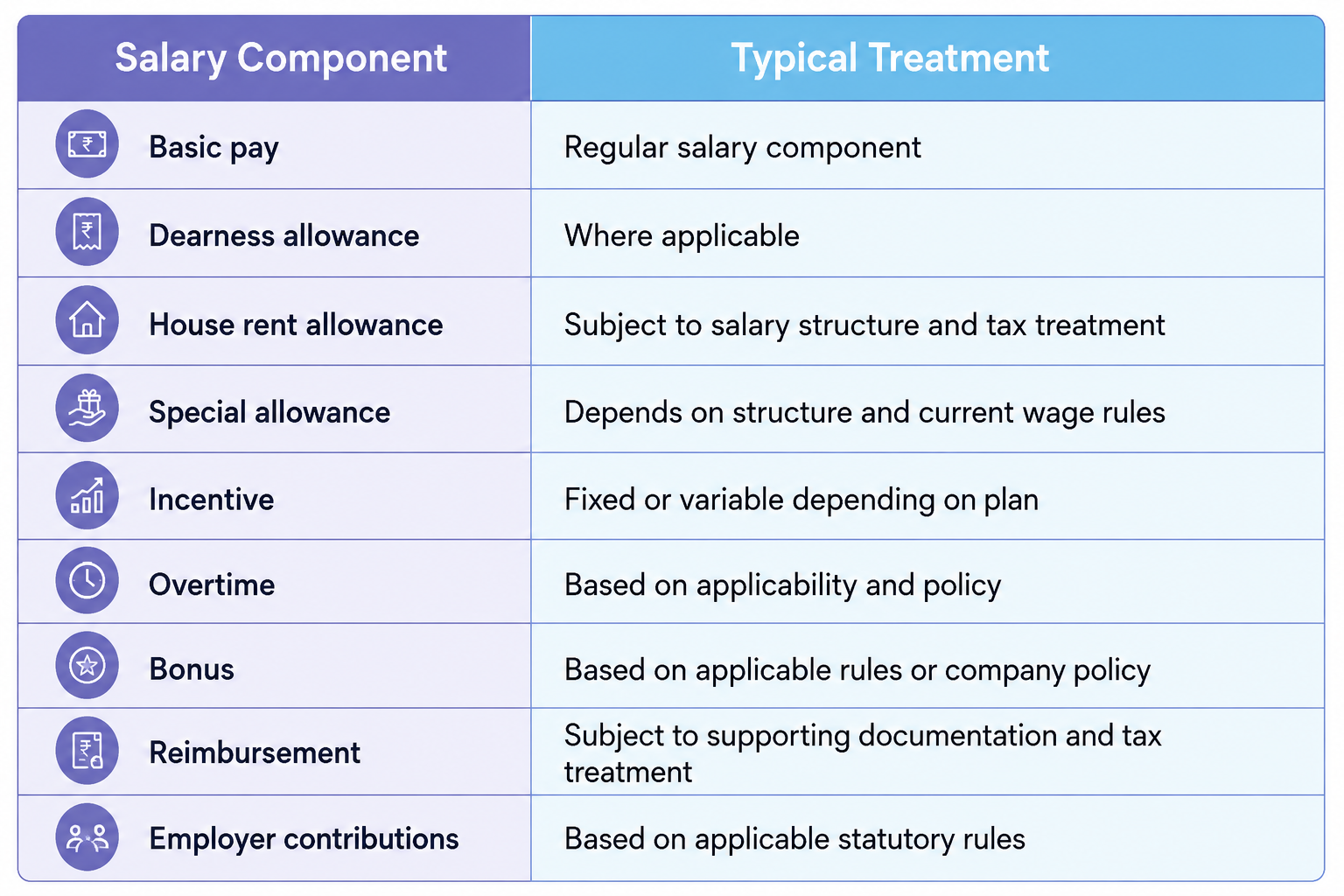
Salary structures should not be designed only around take-home pay.
The revised definition of wages under the Labour Codes makes component classification important. Employers should review structures against applicable laws and current Ministry guidance.
Step 4: Add Variable Payroll Inputs
Variable components can change every payroll cycle.
Examples include incentives, overtime, arrears, bonuses, reimbursements, commissions, unpaid leave adjustments and retrospective salary revisions.
Every variable input should ideally include:
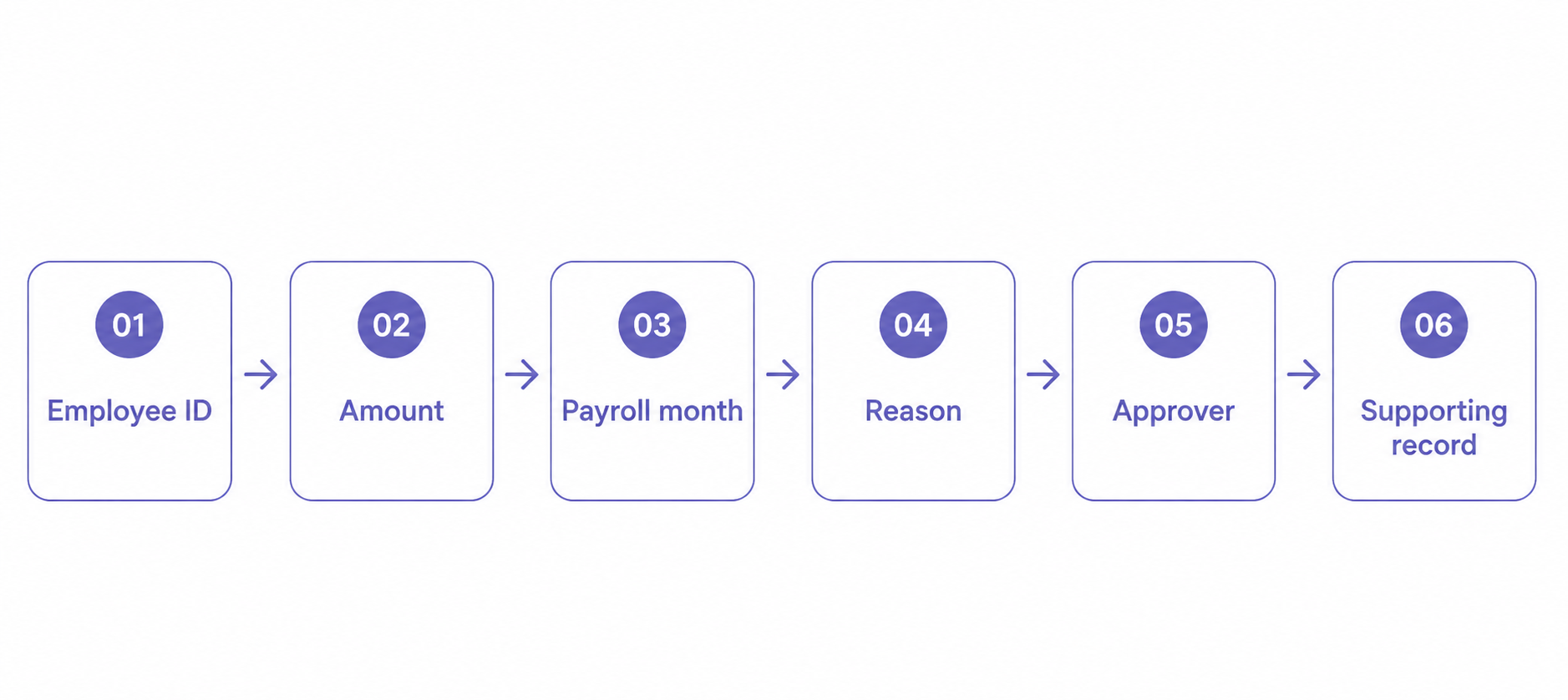
This creates an audit trail.
Verbal instructions or unapproved spreadsheets increase the possibility of overpayments and disputes.
Step 5: Calculate Gross Earnings
Gross earnings are calculated after fixed and variable salary components have been validated.
A simplified example could look like this:
| Component | Amount |
| Basic Pay | ₹30,000 |
| HRA | ₹15,000 |
| Special Allowance | ₹10,000 |
| Incentive | ₹5,000 |
| Gross Earnings | ₹60,000 |
The actual structure will depend on the employment contract, payroll policy and applicable statutory requirements.
Step 6: Calculate Statutory and Other Payroll Deductions
This is one of the most compliance-sensitive parts of the payroll process.
Depending on applicability, deductions can include:
- Employees’ Provident Fund
- Employees’ State Insurance
- Salary TDS
- Professional Tax
- Labour Welfare Fund
- Loan or advance recovery
- Approved benefit deductions
- Other legally permitted deductions
Each item should be independently validated.
Payroll Compliance in India: Key Statutory Components
The following table provides a practical overview for employers.
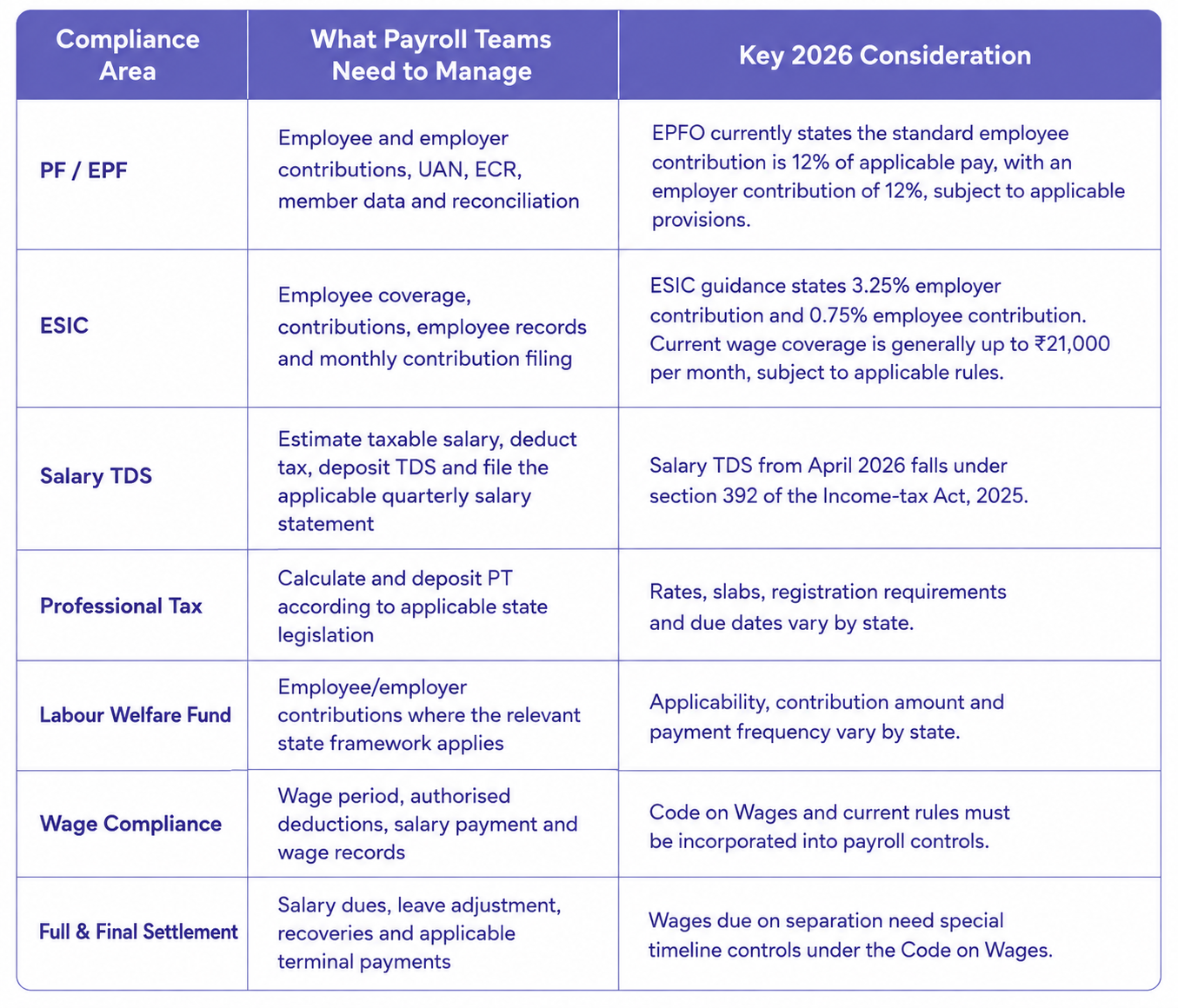
Important: This table is a practical overview, not a substitute for checking the latest central and state notifications applicable to a specific establishment.
PF Payroll Compliance
Provident Fund remains one of the most important payroll controls for covered employers.
EPFO currently states that an employee generally contributes 12% of basic wages, dearness allowance and retaining allowance, with the employer also contributing 12%, portions of which are allocated according to applicable schemes.
EPFO also states that applicable contributions are to be paid within 15 days from the close of the month.
Payroll teams should verify:
- UAN creation and mapping
- Employee eligibility
- PF wage calculation
- Joining and exit information
- KYC data
- ECR data
- Challan reconciliation
- Previous-month corrections
- Employee transfer cases
- Payroll-to-EPFO reconciliation
The revamped ECR framework has introduced additional system validation, which can help prevent some incorrect submissions but also makes accurate source payroll data important.
ESIC Payroll Compliance
ESIC is another major payroll-linked social-security requirement.
Current ESIC guidance specifies a contribution rate of:
Employer: 3.25% of applicable wages
Employee: 0.75% of applicable wages
ESIC also states that contributions should generally be paid within 15 days from the last day of the calendar month in which the contribution becomes due.
The current wage limit referenced by ESIC for general employee coverage is ₹21,000 per month, with a higher threshold for persons with disabilities under applicable provisions.
Employers should verify current applicability before applying these figures to individual employees.
Salary TDS Compliance in 2026
Salary TDS requires special attention this year because of the transition to the Income-tax Act, 2025.
For salary paid from April 2026 onward, employers should calculate withholding according to the applicable provisions under section 392 of the new Act.
The Income Tax Department states that the general TDS deposit timeline remains the seventh day of the following month, with the prescribed March exception for non-government deductors.
Employers should also update payroll systems for the new reporting framework.
The Income Tax Department currently describes Form 138, earlier known as Form 24Q, as the quarterly statement used by employers for salary TDS reporting. The stated filing schedule is:
| Quarter | Period | Due Date |
| Q1 | April–June | 31 July |
| Q2 | July–September | 31 October |
| Q3 | October–December | 31 January |
| Q4 | January–March | 31 May of the following year |
Businesses should configure payroll software, ERP integrations and reporting templates to reflect the new Act and current forms.
Professional Tax in Payroll
Professional Tax is a state-level requirement.
It is not governed by one uniform national rate.
Its applicability may depend on:
- State or Union Territory
- Salary level
- Employee category
- Employer registration
- Work location
- Applicable state legislation
Employers operating in several states should maintain a state-wise PT compliance matrix rather than using one standard payroll rule.
The payroll master should also store the employee’s correct work location because that data can affect PT calculations.
Labour Welfare Fund in Payroll
Labour Welfare Fund requirements are also state-specific.
Depending on the state, there may be:
- Employee contributions
- Employer contributions
- Half-yearly or annual payment cycles
- Different employee eligibility rules
- Different filing or payment procedures
This is particularly important for businesses with employees working across several states.
A central payroll process should therefore contain a state applicability layer rather than assuming the same deductions apply everywhere.
Step 7: Calculate Net Salary
Net salary is the final amount payable to the employee after applicable deductions.
A simplified formula is:
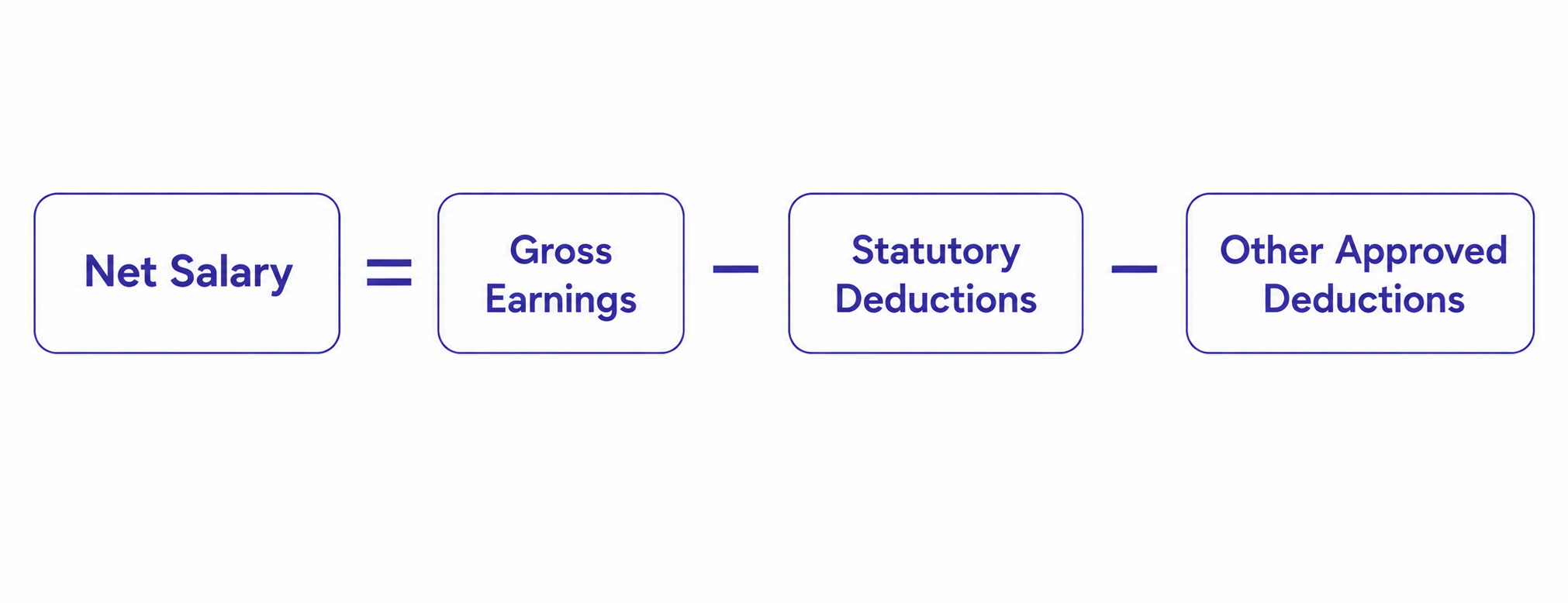
This number should not be released immediately.
Payroll should move into validation first.
Step 8: Run a Pre-Payroll Validation
This is one of the most valuable controls in payroll management.
Before salary is released, the payroll team should compare the current payroll with the previous period.
Useful exception checks include:
| Validation | What to Investigate |
| Salary increased significantly | Increment, arrears or incorrect input |
| Salary dropped sharply | LOP, attendance or deduction issue |
| PF amount changed | Wage change, eligibility or configuration |
| ESIC disappeared | Wage threshold or employee mapping |
| No TDS deduction | Tax projection or declaration issue |
| Duplicate incentive | Repeated variable input |
| Negative salary | Excess recovery or payroll configuration issue |
| Salary for exited employee | Incorrect exit or payroll status |
| New joiner missing | Employee master or cut-off issue |
Instead of manually checking every payslip, payroll teams should focus heavily on exceptions.
This is more scalable as employee numbers grow.
Step 9: Approve and Disburse Salaries
After payroll validation, an authorised stakeholder should approve the final payroll register.
The salary payment file can then be generated and sent through the approved banking process.
Payroll teams should reconcile:
Payroll Register Total = Salary Bank File Total
Any difference should be investigated before upload.
Salary payments should also follow applicable wage-payment timelines.
The Code on Wages states that monthly wages should generally be paid before the expiry of the seventh day of the succeeding month, subject to applicable provisions.
Businesses may choose an earlier payroll date as part of their employment policy.
Step 10: Generate Payslips and Payroll Reports
Employees should receive a clear payslip or wage statement showing relevant salary information.
Typical information includes:
- Earnings
- Deductions
- Net salary
- PF information
- ESIC information where applicable
- Tax deduction
- Leave or LOP impact
- Employee details
- Employer details
Payroll should also create management reports for HR and finance.
Useful reports include:
Payroll register
Department-wise payroll cost
CTC reconciliation
Statutory deduction report
Bank transfer report
New joinee report
Employee exit report
Variance report
Full and final settlement report
These reports turn payroll into a source of business information instead of merely an administrative function.
Step 11: Complete Statutory Payments and Reconciliation
Payroll does not end when employees receive their salaries.
The business must still complete applicable statutory activities.
After payments are made, payroll teams should reconcile:
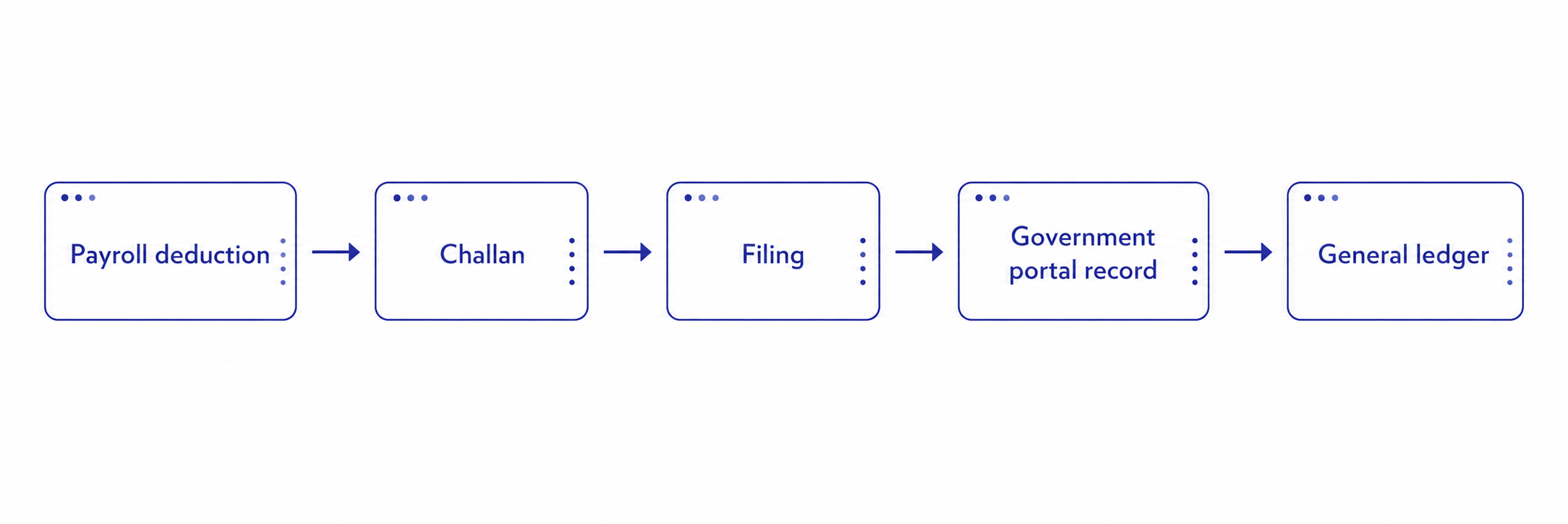
This reconciliation is essential.
A deduction appearing correctly on a payslip does not automatically mean the related statutory payment or filing is correct.
Monthly Payroll Compliance Checklist for Employers
A practical monthly payroll checklist can be organised into four stages.
| Stage | Employer Checklist |
| Before Payroll | Close attendance, validate leave, capture new joiners, process exits, update salary changes and collect variable inputs |
| During Payroll | Calculate salary, PF, ESIC, TDS, PT, LWF and other applicable deductions |
| Before Salary Release | Run variance checks, verify bank details, confirm payroll totals and obtain approval |
| After Payroll | Disburse salary, issue payslips, deposit applicable statutory amounts, complete filings and reconcile payroll |
A business should assign an owner and due date to every activity.
Recommended Monthly Payroll Calendar
A disciplined payroll calendar reduces last-minute errors.
|
Suggested Stage |
Activity |
|
Days 20–25 |
Collect variable inputs and employee changes |
|
Days 25–Month End |
Close attendance and leave |
|
Day 1–2 |
Process preliminary payroll |
|
Day 2–3 |
Run payroll variance and compliance checks |
|
Day 3–4 |
Obtain HR and finance approval |
|
Day 4–7 |
Salary disbursement according to company policy and applicable law |
|
Post Payroll |
Payslips, compliance payments, returns and reconciliation |
The exact calendar can vary by employer.
The important point is to create a repeatable cut-off and approval framework.
How Should Full and Final Settlement Be Managed?
Full and final settlement, or F&F, deserves a separate payroll workflow.
It can involve:
- Salary up to the last working day
- Unpaid salary
- Leave adjustments
- Incentives
- Reimbursements
- Notice pay
- Recoveries
- Loans or advances
- Statutory deductions
- Applicable terminal benefits
- Asset-related recoveries where legally permitted
The Code on Wages provides that wages payable after resignation, removal, dismissal or retrenchment should generally be paid within two working days, subject to applicable provisions.
This makes timely coordination between HR, IT, finance, managers and payroll important.
If employee-exit information reaches payroll late, F&F compliance can become difficult.
10 Common Payroll Challenges Employers Face in India
1. Late Attendance Inputs
Payroll teams cannot process accurate salaries when attendance remains open until the last moment.
Better approach: Create a fixed attendance cut-off with an exception process.
2. Incorrect Employee Master Data
Wrong PAN, UAN, location, bank information or salary structure can create multiple downstream errors.
Better approach: Use maker-checker approval for master-data changes.
3. Frequent Manual Spreadsheet Adjustments
Manual spreadsheets become difficult to control as employee numbers grow.
Better approach: Standardise input templates and restrict direct payroll-file editing.
4. Incorrect Statutory Mapping
Not every employee or establishment has identical statutory applicability.
Better approach: Build rule-based employee and location mapping.
5. Salary Structure Errors
Legacy salary templates may not reflect current wage-definition requirements.
Better approach: Periodically review salary components against current regulations.
6. Multi-State Compliance Complexity
PT, LWF and several employment requirements can vary by state.
Better approach: Maintain a state-wise compliance matrix connected to employee work locations.
7. Employee Exit Delays
Late resignation or termination information can result in salary overpayment or delayed settlement.
Better approach: Connect HR exit workflows directly to payroll.
8. Poor Payroll Reconciliation
A correct-looking payroll register can still contain filing or accounting mismatches.
Better approach: Reconcile payroll with bank records, statutory challans and finance ledgers.
9. Lack of Payroll Audit Trails
When an employee asks why salary changed, HR should be able to trace the answer.
Better approach: Record each variable input, approver and change history.
10. Keeping Up With Regulatory Changes
The Labour Codes, new Income-tax Act and payroll portal updates demonstrate how quickly payroll requirements can change.
Better approach: Assign responsibility for regulatory monitoring and system configuration reviews.
Common Payroll Mistakes Businesses Should Avoid
A strong payroll system is designed to prevent predictable mistakes.
Common errors include processing payroll without an approved cut-off, using outdated salary structures, failing to update new joiners or exits, applying incorrect PF or ESIC rules, missing state-level compliance, using outdated tax configurations, making unapproved deductions and failing to reconcile payroll after payment.
The most expensive payroll problems are often not calculation errors.
They are process-control errors.
A calculator can calculate correctly and still produce the wrong payroll if the underlying data is wrong.
How Can Employers Build a More Reliable Payroll Process?
A reliable payroll function should have three layers of control.
Layer 1: Input Controls
Control what enters payroll.
Every salary change, attendance adjustment, incentive, deduction and employee update should have a clear source and approval.
Layer 2: Processing Controls
Configure payroll rules correctly.
Statutory logic, salary components, state rules, tax calculations and effective dates should be tested before implementation.
Layer 3: Output Controls
Validate what payroll produces.
Use variance reports, reconciliation and maker-checker approvals before money leaves the organisation.
This three-layer model helps reduce dependence on one payroll executive spotting every possible error manually.
Payroll Management Checklist for Employers
Before closing payroll each month, employers should be able to answer yes to the following:
- Is the employee master updated?
- Have all new joiners been added?
- Have resignations and terminations been captured?
- Is attendance closed?
- Is unpaid leave validated?
- Are increments and salary revisions approved?
- Are incentives and reimbursements approved?
- Have payroll rules been updated for applicable regulatory changes?
- Are PF calculations validated?
- Are ESIC calculations validated?
- Is salary TDS calculated under the current tax framework?
- Are PT and LWF rules mapped by state?
- Have payroll variances been reviewed?
- Does the payroll register reconcile with the salary bank file?
- Has an authorised person approved payroll?
- Have payslips been generated?
- Are statutory payments and filings scheduled?
- Has payroll been reconciled with finance records?
- Are all supporting documents retained?
- Are pending employee payroll queries tracked?
A checklist like this reduces dependence on memory.
Should Payroll Be Managed In-House or With Specialist Support?
There is no single answer for every company.
A small organisation with a simple salary structure and employees in one location may be able to manage payroll internally.
The situation becomes more difficult when the business adds:
- More employees
- Multiple states
- Different salary structures
- PF and ESIC complexities
- Frequent employee movements
- Large volumes of payroll inputs
- Compliance notices
- Audit requirements
- Multiple entities
- Tight payroll SLAs
At that point, the business should evaluate whether its internal payroll capacity, technology and compliance expertise can scale with its workforce.
The objective should not simply be to outsource work.
The objective should be to build a payroll process that remains accurate, traceable, compliant and scalable.
When Should an Employer Review Its Payroll Process?
A payroll review is useful when a company experiences recurring salary corrections, employee complaints, unexplained payroll variances, delayed statutory payments, multiple spreadsheet dependencies, state expansion, rapid headcount growth or difficulty reconciling payroll with finance records.
It is also sensible to review payroll when there is a significant regulatory change.
The implementation of the Labour Codes and the transition to the Income-tax Act, 2025 make 2026 an appropriate year for employers to review payroll configurations and controls.
Payroll Management in India Is Becoming a Compliance and Data Discipline
Modern payroll is no longer simply about calculating basic salary, allowances and deductions.
It sits at the intersection of:
HR data + attendance + compensation + tax + social security + labour compliance + finance + employee experience
That makes data quality just as important as payroll software.
A payroll system cannot compensate for incorrect inputs, unclear responsibilities or outdated compliance rules.
Indian employers should therefore treat payroll as a documented operating process with clear ownership, cut-offs, validation rules, statutory calendars and reconciliation.
How Vauras Can Support Payroll Management
Businesses that want specialist support can evaluate Vauras Payroll Management Services for payroll processing and payroll-linked compliance requirements.
The service page covers payroll activities such as salary processing, PF and ESIC support, tax-related payroll requirements, payslips and reporting.
Instead of waiting for payroll problems to become employee complaints or compliance issues, employers can begin by reviewing their current payroll process and identifying gaps in data, controls, statutory mapping and monthly reconciliation.
Is Your Payroll Process Ready for 2026?
Review your current payroll process, statutory calculations and compliance workflow with Vauras.
Conclusion
Payroll management in India has evolved into a structured compliance and data-management function.
Employers need to coordinate employee information, attendance, salary structures, PF, ESIC, salary TDS, Professional Tax, Labour Welfare Fund, payslips, employee exits and financial reconciliation every payroll cycle.
The regulatory changes that took effect across 2025 and 2026 make accurate payroll configuration especially important.
Companies that establish clear payroll cut-offs, validated employee data, maker-checker controls, compliance calendars and monthly reconciliation can reduce avoidable errors while creating a better employee experience.
For growing organisations, the question is no longer simply:
“Can we calculate payroll?”
The more important question is:
“Can our payroll process remain accurate and compliant as the business scales?”
Frequently Asked Questions
1. What is payroll management in India?
Payroll management in India is the process of calculating employee earnings, deductions and net salaries while managing payroll-linked requirements such as PF, ESIC, salary TDS, Professional Tax and Labour Welfare Fund where applicable. It also includes attendance inputs, payslips, payroll reporting, compliance payments and reconciliation.
2. What are the main steps in the payroll process in India?
The payroll process generally includes employee-data validation, attendance closure, variable-pay collection, salary calculation, statutory deductions, payroll validation, salary disbursement, payslip generation, statutory compliance and post-payroll reconciliation.
3. Which statutory deductions can apply to payroll in India?
Depending on the employer, employee, state and applicable rules, payroll deductions can include PF, ESIC, salary TDS, Professional Tax and Labour Welfare Fund contributions. Employers should verify the latest central and state requirements before processing payroll.
4. What changed in payroll compliance in 2026?
The four Labour Codes have been effective since 21 November 2025. Employers also need to consider the revised definition of wages. In addition, salary TDS for relevant payments from April 2026 is governed by the Income-tax Act, 2025, with salary withholding covered under section 392.
5. What is the 50% wage rule under the Labour Codes?
The Labour Ministry’s FAQs explain that where excluded allowances and benefits exceed the prescribed 50% level of remuneration, the excess is added back to wages for statutory purposes. Employers should review salary structures against the official wage definition and applicable rules.
6. What is the current ESIC contribution rate?
Current ESIC guidance states that the employer contribution is 3.25% of applicable wages and the employee contribution is 0.75%. Applicability should always be checked against current ESIC provisions.
7. What is the PF contribution rate for employees?
EPFO currently states that the standard employee contribution is 12% of basic wages, dearness allowance and retaining allowance, with an employer contribution of 12%, subject to applicable provisions and scheme rules.
8. Is Professional Tax the same across India?
No. Professional Tax is governed at the state level. Rates, salary slabs, payment schedules and employer obligations can differ between states. Multi-state employers should maintain separate state-wise compliance rules.
9. How quickly should full and final salary be processed after resignation?
The Code on Wages provides that wages payable after resignation, dismissal, removal or retrenchment should generally be paid within two working days, subject to the applicable provisions and circumstances.
10. When should a business consider professional payroll management support?
A business should consider specialist support when payroll complexity increases because of headcount growth, multiple locations, frequent employee changes, statutory obligations, recurring errors, audits, compliance notices or limited internal payroll expertise.