

To choose a payroll and compliance company in India, check whether it can manage your salary process and the compliance obligations that apply to your workforce. Ask for a written service scope, location coverage, approval process, sample reports, and clear responsibility for filings and payments. Compare fees only after these requirements are understood.
The main question is straightforward: What work will the provider complete, and what will your business still need to do?
A proposal may include salary calculations but exclude statutory submissions. Another may prepare a contribution challan while leaving payment and reconciliation to your finance team. Both arrangements can work, provided the boundaries are clear.
This guide helps SME owners, HR heads, finance managers, factories, schools, and other employers assess those boundaries before signing an agreement.
What Does a Payroll and Compliance Company Do?
A payroll and compliance company provides agreed support for employee pay administration and the related legal requirements.
Payroll processing covers the calculation and administration of employee earnings and deductions. Compliance support addresses the applicable rules, registrations, contributions, submissions, and records connected with employment.
The two functions need to work together. A salary deduction appearing on a payslip does not, by itself, establish that the corresponding statutory submission or payment has been completed.
Payroll services may include
- Maintaining employee and salary records.
- Processing approved attendance, leave, and variable pay.
- Calculating earnings, deductions, and net salary.
- Preparing payslips and payment instructions.
- Processing arrears and exit settlements.
- Providing payroll summaries for finance.
Compliance services may include
- Assessing which obligations apply.
- Supporting PF and ESIC administration.
- Preparing agreed returns and contribution records.
- Supporting Professional Tax and Labour Welfare Fund requirements where applicable.
- Maintaining prescribed employment records.
- Tracking regulatory changes.
- Assisting with inspections, notices, and corrections.
Treat this as a scope discussion, not a standard package. Ask each provider to mark every activity as included, excluded, or separately chargeable.
When Should an Employer Consider Combined Support?
Combined payroll and compliance services are worth considering when different people handle connected tasks without a reliable handover.
For example, HR may maintain attendance, accounts may calculate salaries, and an external consultant may prepare statutory submissions. If each uses a different employee list, errors can pass from one stage to the next.
Consider combined support when:
- Payroll corrections recur each month.
- Employees join or leave frequently.
- Your business operates across multiple locations.
- Shift work, overtime, or incentives complicate calculations.
- Filing records are difficult to retrieve.
- HR and finance disagree about who owns a task.
- Existing compliance issues need a separate review.
Outsourcing is not automatically the right answer for every employer. A capable internal team with suitable systems and specialist advice may manage the process well. The decision should reflect the work required, internal capacity, and level of control you want to retain.
Choose the Service Arrangement Before Choosing the Company
Start by deciding whether you need software, operational support, compliance expertise, or a different employment arrangement.
| Arrangement | What you are buying | What to clarify |
|---|---|---|
| Payroll software | Tools for calculations, records, and reports | Who operates the system and checks compliance? |
| Managed payroll | An external team performing agreed payroll tasks | Which compliance activities accompany processing? |
| Compliance support | Specialist help with agreed employment obligations | Who supplies payroll data and implements corrections? |
| Combined payroll and compliance | Coordinated delivery across both functions | Who owns each handover and unresolved issue? |
| Third-party payroll | A workforce arrangement involving another payroll employer | Who employs the workers, and which obligations remain with each party? |
An employee management system can help organise attendance, leave, and employee information. However, access to a system does not establish who performs the work or accepts responsibility for checking it.
Also, do not assume that every provider uses “payroll outsourcing” in the same way. Ask directly whether your employees remain employed by your organisation.
How to Evaluate a Payroll and Compliance Company in India
Evaluate the provider against your actual establishment and workforce. Broad claims about complete compliance are less useful than a documented explanation of how your account will operate.
1. Check establishment and location coverage
Ask the provider to assess your legal entities, work locations, establishment type, employee categories, and contractor arrangements.
A factory, school, office, and retail establishment may require different assessments. The provider should explain which requirements apply and which information it needs before reaching a conclusion.
India’s four Labour Codes became effective on 21 November 2025, according to the Government of India announcement. Buyers should therefore ask how proposals reflect the current framework and relevant rules, rather than accepting an undated list of older legislation. The Ministry of Labour and Employment maintains official Code documents, rules, and guidance.
Ask:
- Which locations can your team support?
- Who checks applicability for our establishment?
- How are new branches assessed?
- Which official notifications support your recommendations?
- What specialist work falls outside your regular service?
An “India-wide” service description should be supported by a clear explanation of delivery in your locations.
2. Separate calculation, submission, payment, and reconciliation
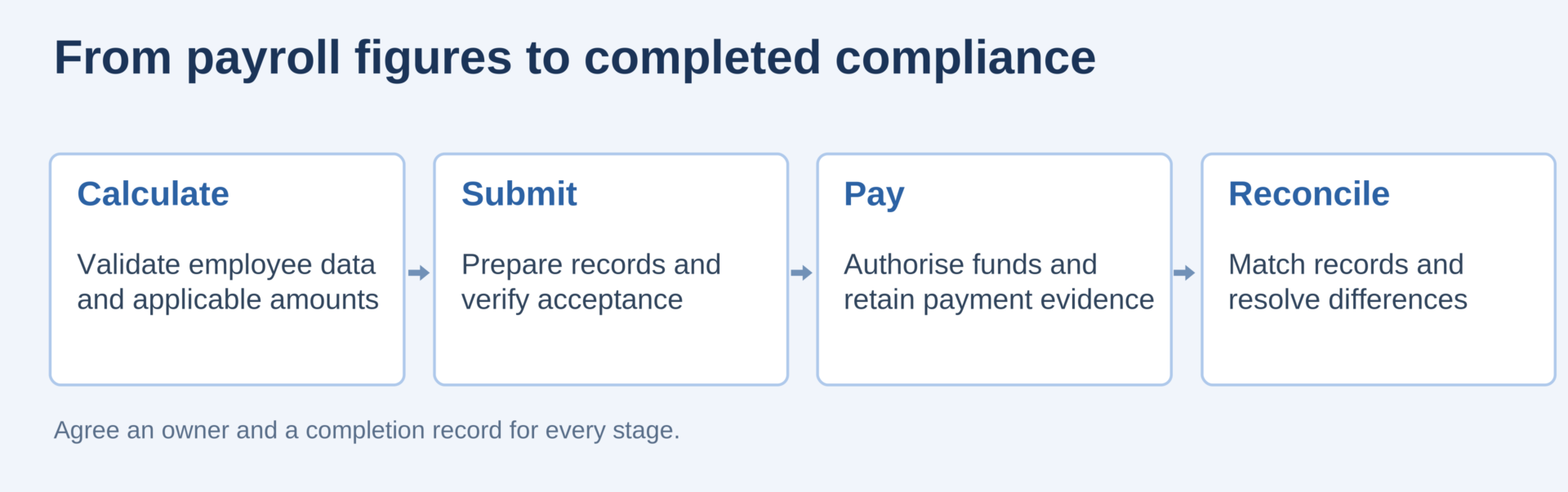
These are different stages. A provider completing one stage may not be responsible for the others.
For each applicable obligation, document:
| Stage | Question to settle before signing |
|---|---|
| Calculation | Who checks the employee data and contribution basis? |
| Preparation | Who prepares the return, file, or challan? |
| Submission | Who submits it and verifies acceptance? |
| Payment | Who supplies funds and authorises payment? |
| Reconciliation | Who matches payroll, submissions, and payment records? |
| Correction | Who investigates differences and completes follow-up? |
This is central to statutory compliance in payroll. You need a traceable connection between employee records, payroll figures, submitted information, and payment evidence.
Ask what the provider considers “completed.” Preparation alone should not be reported as a completed payment.
3. Review the monthly evidence you will receive
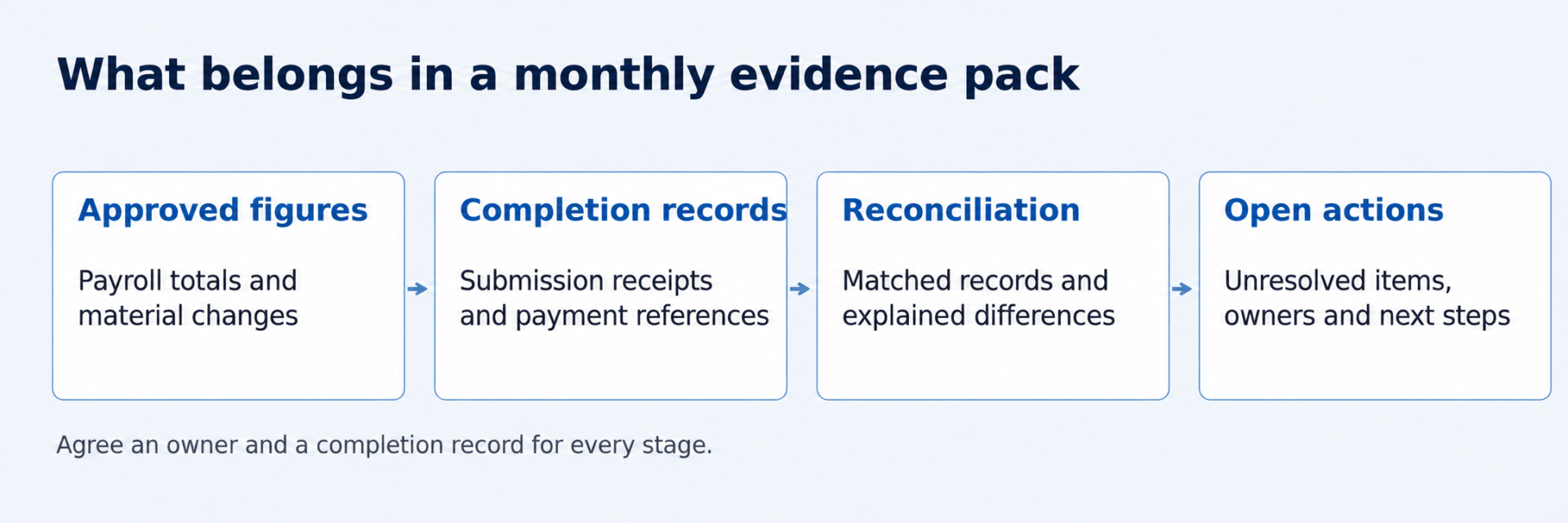
Ask for an anonymised example of the records supplied after each cycle.
A useful evidence pack could contain:
- Approved payroll totals.
- A summary of material changes.
- Applicable submission acknowledgements.
- Payment confirmations or references.
- Reconciliation results.
- Unresolved exceptions.
- Outstanding employer actions.
The format matters less than whether the records can be checked.
For example, if an employee appears in the payroll register but is missing from an applicable contribution record, the report should identify the difference, responsible person, and next action.
Avoid relying entirely on a dashboard status such as “done” without access to supporting records.
4. Test how payroll and compliance teams handle exceptions
Ask the provider to demonstrate a difficult case using fictional employee data.
Possible scenarios include:
- An employee joining midway through the month.
- An exit entered after attendance closes.
- A retrospective salary revision.
- Incorrect employee identification details.
- A difference between payroll deductions and statutory records.
The demonstration should show who investigates the issue, who approves a correction, and how the change reaches every affected output.
This tests coordination. A provider may have competent payroll and compliance teams but still lack a reliable process between them.
5. Define responsibilities that remain with the employer
Your business will still need to supply accurate information, approve decisions, and fulfil the obligations assigned to it.
Do not treat outsourcing as an automatic transfer of statutory liability. Employment arrangements and applicable law matter. For contractor-related PF compliance, EPFO has specifically explained principal-employer responsibilities and facilities for checking contractor remittances.
Agree who will:
- Authorise employee and salary changes.
- Confirm attendance and overtime.
- Approve payroll.
- Arrange salary and statutory funding.
- Review exceptions.
- Maintain access to employer records.
- Respond to requests for documents.
Keep at least one internal owner who understands the overall process.
6. Distinguish current work from historical problems
A monthly service should not silently absorb an undefined backlog.
Before requesting proposals, list known issues such as missing records, unreconciled periods, employee-data errors, or open notices.
Ask for separate scope covering:
- The periods to be reviewed.
- Available and missing documents.
- Diagnostic work.
- Proposed corrections.
- Dependencies and limitations.
- Additional fees.
A provider should investigate an unfamiliar issue before promising a particular outcome. Inspection assistance also needs a defined scope; it should not be confused with a guarantee that an authority will close a matter.
7. Check data handling and system compatibility
Payroll involves salary, identity, and bank information. Ask how access is controlled throughout the service.
Review secure transfer methods, authorised users, access removal, backups, incident reporting, and subcontractor involvement. If a certification is presented, check its validity and whether it covers the service being purchased.
Then test how your existing attendance or employee management system connects with the provider’s workflow.
Confirm whether the connection uses spreadsheets, standard imports, or an integration. Establish who maintains it and who resolves rejected or incorrect records.
8. Compare total cost and exit conditions
Request pricing against the same requirements from every shortlisted provider.
Compare:
- Recurring fees and minimum charges.
- Implementation and data-cleaning costs.
- Integration charges.
- Additional payroll runs.
- Historical corrections.
- Notice and inspection assistance.
- Employee support.
- Contract renewal and exit charges.
Keep service fees separate from salary funding and statutory payments.
Combined support can reduce handovers, but it may also increase dependence on one provider. Agree how your records, pending issues, and account knowledge will be transferred if the engagement ends.
A Practical Example: Compare Scope Before Price
Consider a hypothetical manufacturer with 75 employees, shift attendance, overtime, and workers supplied through a contractor.
Provider A offers a lower fee for salary calculations and payslips. Provider B quotes more and includes an agreed compliance review, reconciliation, and monthly evidence pack.
Neither proposal is automatically better.
The employer should establish:
- Whether contractor compliance is included.
- Who validates overtime inputs.
- Which submissions each provider completes.
- Who checks payments against employee records.
- How much work remains with HR and finance.
If Provider A’s exclusions require another consultant and substantial internal follow-up, its lower processing fee may not represent the lower overall cost.
This is an illustrative purchasing example, not a Vauras client result.
Use This Checklist Before Signing
Use the following as a decision tool. An unanswered essential item should trigger clarification before appointment.
|
Check |
Evidence to request |
|---|---|
|
Suitable employment arrangement |
Written explanation of who employs the workers |
|
Relevant location coverage |
Establishment and location scope |
|
Defined payroll deliverables |
Monthly output list |
|
Defined compliance responsibilities |
Task and responsibility matrix |
|
Reliable completion evidence |
Anonymised monthly evidence pack |
|
Clear exception handling |
Demonstrated correction workflow |
|
Protected employee information |
Documented access and transfer controls |
|
Separate historical work |
Backlog assessment and quote |
|
Controlled implementation |
Data-validation and parallel-run plan |
|
Transparent commercial terms |
Full fee schedule and exit provisions |
Do not let an attractive presentation compensate for an unresolved responsibility gap.
What Should You Ask Vauras?
Begin with the service arrangement and scope you require.
Vauras’s published services describe payroll process management, third-party payroll, and labour compliance consulting. Its published service information includes payroll administration and PF/ESIC-related support. These are starting points for a proposal discussion; confirm deliverables, location coverage, service commitments, and fees for your business.
For a Vauras payroll consultation, provide:
- Company name and establishment type.
- Employer location and operating states.
- Employee count and contractor workforce, if any.
- Required payroll and statutory compliance services.
- Current systems and pay cycle.
- Existing errors, notices, or pending work.
- Desired start date.
- Decision-maker’s name, designation, and business contact details.
You can explore Vauras payroll and compliance services and use the enquiry form to explain these requirements. Share sensitive employee records later through an agreed secure process.
Conclusion
Choosing a payroll and compliance company in India starts with understanding the complete process, from employee inputs to verified compliance records.
Look for a provider that explains its scope, checks the rules relevant to your establishment, documents responsibilities, and shows how exceptions are resolved. A useful proposal makes both the provider’s work and your remaining workload visible.
Before committing, request a written scope and sample deliverables. Those documents provide a stronger basis for a decision than a broad promise of hassle-free compliance.
Frequently Asked Questions
1. Can one company manage payroll, PF, ESIC, and labour compliance?
Yes, one company can provide these services under an agreed scope. Confirm which activities it performs directly, which require specialist support, and whether calculations, submissions, payments, and reconciliation are all included.
2. Does outsourcing payroll remove the employer’s compliance responsibility?
No. Outsourcing does not automatically remove obligations attached to the employer or principal employer. Responsibilities depend on the applicable law and employment arrangement, as well as the tasks allocated in the contract.
3. Should a small business choose software or managed services?
Choose according to your internal capacity. Software may suit a business with people who can operate it and manage compliance. Managed services may help when the business needs operational support. Compare the work remaining with your team.
4. Are all statutory compliance services included in a payroll package?
No. A package may cover calculations while excluding registrations, submissions, historical corrections, or notice assistance. Request a detailed inclusion and exclusion list before comparing prices.
5. What should an employer check before switching providers?
Check employee records, opening balances, prior payroll outputs, compliance records, outstanding issues, and access permissions. Agree a handover date, test the new process, and identify who completes work relating to earlier periods.