
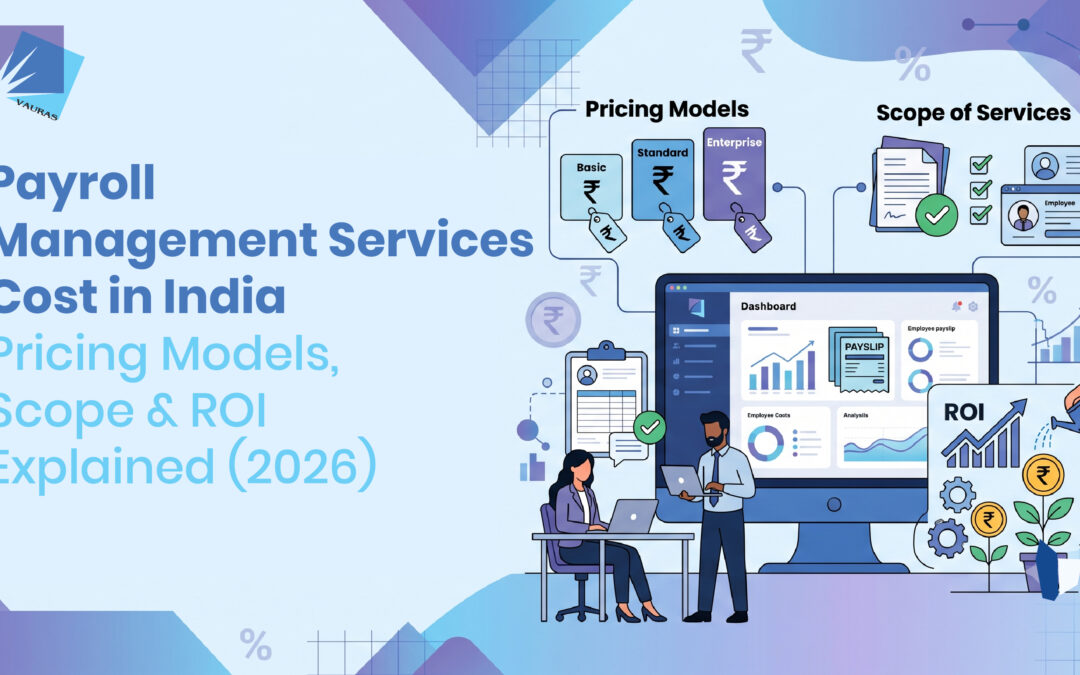
Pricing Models Scope and ROI Explained for 2026
Payroll management services cost in India depends on employee count, the work included, payroll complexity, locations and implementation requirements. Providers may quote a per-employee monthly charge, a fixed retainer, a minimum fee or a combination. Compare the total annual cost for an agreed scope, including setup and exceptions, rather than relying on the headline rate.
There is no useful single price for every employer. A proposal covering salary calculations and payslips is different from one that also includes payroll-linked filings, reconciliation, employee support and multiple entities. Software subscriptions introduce another comparison: buying access to a platform does not necessarily buy a team to operate the full payroll process.
This article explains how to evaluate payroll services pricing and build a practical return-on-investment calculation. All worked amounts below are hypothetical procurement examples, not Vauras prices, market averages or client results. Vauras’s public pages reviewed for this article do not provide a standard payroll management tariff; request a written quote for your requirements.
First identify the payroll service you are buying
For payroll process management, employees remain on your company’s payroll and the provider performs agreed payroll activities. This is the model described by Vauras for its payroll management services.
Third-party payroll can involve a different employment arrangement. Vauras describes its separate outsourcing offering in those terms. Do not combine that quote with a processing-only proposal without checking the legal employer and included obligations. If your employees remain on your payroll, make that condition explicit in the request for quotation.
For a complete explanation of the activities that can form the scope, use Vauras’s payroll process and compliance guide. The pricing discussion should follow that operational map.
Common payroll management pricing models
|
Pricing model |
How billing works |
What to clarify |
|---|---|---|
|
Per employee per month |
Billable employees multiplied by an agreed rate |
Meaning of a billable employee and headcount date |
|
Fixed monthly retainer |
One fee for a defined workforce and scope |
Headcount ceiling and charges above it |
|
Minimum fee plus variable rate |
A floor applies before or alongside employee charges |
Whether the minimum replaces or adds to usage fees |
|
Tiered pricing |
Rate or total changes at headcount bands |
Whether the new rate applies to all employees |
|
Core package with add-ons |
Routine payroll plus separately priced services |
Filings, support, extra runs and integrations |
|
Custom enterprise quote |
Fees reflect entities, locations and workflow |
Change requests and ongoing support boundaries |
Per employee pricing
Per-employee-per-month pricing, often shortened to PEPM, can make recurring costs easy to estimate. However, the invoice depends on the billing definition. Ask whether joiners, leavers, unpaid employees and off-cycle recipients count, and whether the provider bills on opening, closing or peak headcount.
In an illustrative quote, 100 billable employees at ₹180 each create a ₹18,000 monthly processing fee. If the proposal has a ₹20,000 minimum that replaces a lower calculated fee, the invoice is ₹20,000 before separately priced items and applicable tax. If the minimum is actually a base fee added to usage, the result is different. The contract must remove this ambiguity.
Fixed retainers and tiered plans
A retainer helps budgeting when payroll activity is stable. Ask what happens after hiring increases the workforce or a new location is added. A “fixed” fee may apply only within a defined volume and service boundary.
For tiered plans, test the invoice at the threshold. A quote can charge a new rate for every employee once a band is crossed, or apply that rate only to additional employees. These methods produce different costs. Request examples at your current headcount and your expected headcount in six and twelve months.
Why software subscription prices are different
Public payroll software pages are useful for understanding pricing structures, but they are not a national benchmark for fully managed payroll. For example, Zoho Payroll’s plan comparison shows product plans and feature differences. RazorpayX Payroll’s pricing page describes its own packages and employee-based pricing.
Before comparing a software bill with a service quote, add the internal work needed to collect inputs, configure calculations, review outputs, handle questions and complete excluded compliance tasks. Conversely, check whether the managed-service proposal includes technology access or expects you to retain a separate subscription.
Product offerings and prices can change. Review the live pages and written service terms when purchasing. A provider’s software or payment features should not be assumed to cover every task in your payroll calendar.
What a payroll management fee should cover
Start with a scope checklist. For every item, mark it as included, excluded or separately charged, and assign an owner. This lets finance compare proposals without losing the operational detail.
|
Scope area |
Deliverables to specify |
Common pricing question |
|---|---|---|
|
Employee records |
Approved master updates and joiner or leaver changes |
Are unlimited monthly changes included |
|
Salary processing |
Earnings, deductions, arrears and net pay |
Is one monthly cycle the only included run |
|
Payslips and payment outputs |
Payslips and agreed bank file |
Is portal access or distribution extra |
|
Payroll-linked compliance |
Agreed calculations, filings and evidence |
Does the quote cover filing or calculation only |
|
Employee support |
Defined queries and escalation |
Are direct employee queries included |
|
Finance reporting |
Cost-centre totals and reconciliations |
Are customised reports separately priced |
|
Employee exits |
Full and final calculations within agreed scope |
Is there a per-settlement fee |
|
Year-end support |
Agreed employee tax and reporting outputs |
Which activities attract annual charges |
Pay particular attention to statutory work. Calculating a deduction, preparing a filing, submitting it and confirming payment are separate steps. A broad compliance label can conceal differences between proposals. Wider establishment obligations may belong in a separate compliance management engagement.
The main factors that change payroll cost
Workforce size and monthly activity
Headcount affects processing volume, but the number of changes matters too. Frequent hiring, exits, salary revisions and incentive adjustments create additional validation. A stable 150-person payroll can require a different workload from a similarly sized workforce with high monthly turnover.
Tell providers how many changes you normally process. Ask whether the employee rate assumes a standard number of runs or transactions and whether recurring exceptions can be bundled rather than charged unpredictably.
States establishments and legal entities
Different locations can require separate applicability checks, registrations, reporting and reconciliation. Professional Tax and Labour Welfare Fund are examples of location-sensitive requirements; the exact treatment must be checked for the relevant establishment and workforce.
Multiple legal entities can also need separate employee records, approvals and outputs. Ask whether pricing is per organisation, entity, registration or employee. Do not assume one group-wide headcount produces one consolidated fee.
Salary structures attendance and variable pay
Shift attendance, overtime, arrears, commissions and changing reimbursements require clear inputs and testing. The fee can also reflect the need to review salary components and configure statutory treatment.
The Labour Ministry’s additional Labour Code FAQs explain aspects of the wage definition and remuneration components. Quote requests should distinguish an initial wage-structure review from routine monthly processing. Vauras’s Labour Codes compliance checklist provides context for that wider review.
Input quality and historical corrections
Incomplete employee records, inconsistent statutory identifiers and unreconciled opening balances can increase onboarding effort. Historical rectification should be identified before launch, with a separate deliverable and fee where necessary.
Do not ask a new provider to absorb unknown legacy work into an ordinary monthly charge. A defined remediation scope makes both the price and completion criteria easier to assess. Specialist PF and ESIC support may be relevant where those records need attention.
Integrations reporting and support commitments
A standard spreadsheet import differs from building and maintaining a connection to an attendance system or accounting platform. Custom cost-centre reporting, faster correction windows and extended employee support can also change resource requirements.
Request a clear division between setup and recurring maintenance. If a vendor changes its file format or your HR system is replaced, the contract should explain how integration changes are authorised and priced.
Charges to check before signing
Potential additional charges are not automatically unfair; the problem is an undefined scope. Ask about data migration, opening-balance reconciliation, parallel payroll, setup, additional legal entities, new registrations, historical corrections, off-cycle runs, settlements, custom reports and employee support.
Also check notice handling, inspection assistance, annual reporting, software licences and exit handover. Determine whether a provider-caused correction is included and how employer-requested changes after the cutoff are charged. The same correction should not be billed under several overlapping labels.
Keep pass-through costs and statutory amounts separate from professional fees. Employer contributions and salaries are workforce expenses, not provider revenue simply because a service partner helps process them. Compare tax-exclusive professional fees consistently, then assess applicable taxes and recoverability with finance.
A worked comparison of two hypothetical quotes
Assume a company has 100 billable employees throughout the year, one legal entity and the same agreed location scope in both proposals. Both quotes cover routine monthly payroll. Quote B also includes the specific additional support listed below. All amounts are invented to demonstrate the calculation.
|
Cost item |
Quote A |
Quote B |
|---|---|---|
|
Monthly employee fee |
100 × ₹120 = ₹12,000 |
100 × ₹180 = ₹18,000 |
|
Monthly compliance service fee |
₹5,000 |
Included |
|
Four additional runs during the year |
4 × ₹2,000 = ₹8,000 |
Included within agreed limit |
|
Annual reporting support |
₹12,000 |
Included within agreed scope |
|
First-year setup fee |
₹15,000 |
₹10,000 |
|
Total first-year fees before tax |
₹2,39,000 |
₹2,26,000 |
|
Subsequent annual fees at unchanged scope |
₹2,24,000 |
₹2,16,000 |
Quote A’s first-year total is ₹12,000 × 12 plus ₹5,000 × 12 plus ₹8,000 plus ₹12,000 plus ₹15,000. Quote B’s total is ₹18,000 × 12 plus ₹10,000. The higher employee rate produces the lower annual fee in this example because the quoted inclusions differ.
This does not establish that a more expensive employee rate is usually better. Change the activity volumes or exclusions and the result can reverse. Before choosing, confirm that both proposals meet the same control, compliance and support requirements.
Build your total cost of ownership calculation
First-year payroll service cost equals recurring professional fees plus implementation, integrations, expected additional work and retained internal effort. Add applicable non-recoverable taxes consistently. Track salaries and statutory contributions separately so they do not distort the provider comparison.
Estimate internal effort using actual tasks: preparing inputs, checking draft payroll, authorising payments, resolving issues and reviewing reconciliations. Multiply the expected hours by a realistic fully loaded hourly cost. Outsourcing processing does not remove every internal responsibility.
Calculate a second-year view without one-time onboarding costs, while including renewal assumptions. Model your current headcount, planned growth and a higher-exception scenario. If the fee only looks attractive when there are no corrections or exits, the budget is unlikely to reflect normal operations.
Calculate payroll service ROI without overstating savings
Use a measured baseline for your existing process. Record staff time, software fees and recurring correction costs before estimating the future process. Include payroll review and vendor management in the future cost.
A hypothetical company currently spends 60 payroll-related hours per month at a fully loaded cost of ₹500 per hour, or ₹30,000, plus ₹5,000 in monthly software expense. Its monthly economic baseline is therefore ₹35,000.
Suppose a managed service costs ₹18,000 monthly and the employer still spends 12 hours on inputs, approvals and review, costing ₹6,000. The future monthly total is ₹24,000, producing an estimated ₹11,000 improvement, or ₹1,32,000 annually before setup. With a ₹10,000 setup fee, the first-year net improvement is ₹1,22,000.
For a defined procurement ROI measure, divide that first-year net improvement by the first-year provider investment of ₹2,26,000 and multiply by 100. The result is approximately 54%. Estimated setup payback is ₹10,000 divided by ₹11,000, or about 0.9 months after steady-state savings begin. These are illustrative calculations, not promised returns.
Released staff time is an economic benefit, not automatically cash savings. If salaries remain unchanged, describe the result as capacity freed for other work. Count cash savings only when costs are actually removed or avoided. Do not add speculative penalties avoided to the base case, and do not count the same saved time twice.
Match the quote to your business situation
A smaller employer with clean records and one location may prioritise a simple minimum-fee package, clear monthly outputs and defined support. A growing employer should test the effect of hiring, new branches and increased settlements on the annual budget.
A business with multiple entities should ask for entity-wise outputs, consolidated reporting and the corresponding charges. A company with unresolved statutory records should separate ongoing processing from historical remediation. These are planning scenarios; the right scope depends on your records and obligations rather than a fixed headcount rule.
For a Kolkata-based company expanding beyond West Bengal, ask how the proposal will account for each new work location. A provider’s office address alone is not evidence of complete coverage in every state. Require a written location and service matrix.
What to send Vauras for a tailored payroll quote
Vauras is based in Kolkata and offers payroll process management alongside PF, ESIC and statutory compliance support. Its published service description keeps employees on the client’s payroll under the management model. Ask for a proposal that translates these service areas into your actual monthly deliverables.
Send your employee count and hiring forecast, legal entities and locations, salary components, attendance tools, pay calendar and usual monthly changes. Add desired filings, reporting, employee support, integrations and any historical issues. Request separate figures for recurring fees, setup and optional work.
Contact Vauras for a tailored payroll management quote and request a scope-led discussion before comparing the price. Confirm the payroll calendar, approval controls, support and exit handover alongside the commercial terms.
Frequently Asked Questions
What is the average payroll management services cost in India ?
An unsourced average can be misleading because service scope varies. Request quotes using the same workforce profile and deliverables, then calculate the annual total. The hypothetical amounts in this article demonstrate comparison methods and are not national market rates.
Does the monthly fee include PF and ESIC filings?
It depends on the contract. Ask separately about applicability review, calculations, submission, payment coordination and reconciliation. A fee that includes deductions may still exclude filings or historical corrections.
Are implementation fees charged only once?
Initial migration and setup may be one-time charges, but new entities, integrations or major configuration changes can create later fees. Check which changes trigger a new project and require written approval before additional work starts.
Can payroll pricing increase when headcount falls?
The effective cost per employee can rise when a minimum fee remains unchanged but fewer employees are processed. Check minimum billing, bands and how headcount is measured before estimating savings from workforce changes.
Does payroll outsourcing always reduce cost?
No. Results depend on the existing workload, the service purchased and retained internal effort. Specialist support may improve controls or capacity even where direct expenditure rises. Evaluate cost, service reliability and evidence separately.
Are salaries and statutory contributions part of the service fee?
They should be distinguished in the comparison. Salaries and employer statutory contributions are workforce expenses; the professional fee pays for agreed services. If a quote combines them, ask for a clear breakdown before comparing it with a processing-only proposal.
How can we reduce payroll costs without weakening checks?
Improve employee records, close attendance on time, standardise inputs and reduce repeated corrections. Choose reporting and support that match actual needs, while retaining approval, reconciliation and applicable compliance controls.
Does Vauras publish fixed payroll management prices?
The public service pages reviewed for this article do not provide a standard tariff. Request a tailored written proposal based on employee count, locations, scope and implementation needs. The example fees above are not Vauras prices.